
This article will describe my cultural experiences and exploration of North and Central India. My Experiences of India is a long story. It describes a three month trip. Read what you can. I suggest reading this article like you would a book, chapter by chapter:
India boasts one of the most ancient civilizations, weaving a glorious history that stretches over thousands of years. From the grandeur of its architecture to the depth of its philosophies, every aspect of Indian culture is steeped in history. The ancient Indus Valley civilization, the footsteps of Mauryas and Guptas, and the vibrant epochs of Mughal reign contribute richly to the cultural mix we witness today.
Historical places like the majestic temples of Khajuraho or the timeless ruins of Hampi offer glimpses into the past without requiring hefty entrance fees. Many of these sites are UNESCO World Heritage spots, ensuring they remain accessible to everyone. Exploring these places gives a sense of walking through history, allowing ancient stones and structures to narrate their timeless tales. My favorite city of India is Vrindavan. It is a city of some five thousand temples and Vaisnava legend. It has about 5,500 temples and I lived in one of them for a couple of weeks. It is a pilgrimage center on the “Krishna Pilgrimage Circuit”.
It is ancient but was lost to history until around 1515 when Sri Chaitanya Mahaprabhu visited there to rediscover the sites where they believed the god Krishna lived and spent time. Many locations of Krishnas’ early life were uncovered by Sri Chaitanya Mahaprabhu. Devotees here will show you where Sri Krishna danced the Rasa Lila with the 108 Gopi girls, the bathing pool of Radha and also that of Krishna. You will be shown several places where Sri Krishna defeated various demons.
India’s timeless traditions manifest vividly in its colorful festivals, art forms, and literature. Whether it’s the poetic epics recited in rural gatherings or classical music concerts echoing through city halls, these ancient sounds and stories offer cultural richness at minimal cost. Public festivals like Diwali, Holi, and Durga Puja are celebrated with much fanfare, inviting locals and visitors alike to join the revelry with open arms. And the festivities are everywhere. Just leave your hotel room, walk into the streets, glory in the colors, sounds, and foods of Indias’ holy days.
Spirituality runs deep in Indian culture, rooted in the teachings of ancient texts like the Vedas and Upanishads. Cities like Varanasi and Rishikesh are steeped in spiritual tradition, offering free meditation and yoga sessions for those seeking inner peace. These practices, accessible to all, emphasize India’s enduring commitment to spirituality and wellness. Connecting with these traditions brings a deeper understanding of how these age-old practices continue to influence modern life.
I navigated Indian cities and villages on a very tight budget.
Exploring India’s sprawling cities doesn’t have to be an expensive affair. With a bit of planning, navigating the vibrant streets of Delhi, the bustling lanes of Mumbai, or the regal avenues of Jaipur can be affordable and deeply rewarding. I did not have to walk 10,000 steps in the cities of India because I did not have that daily step goal when I was there but I probably did. I always loved to walk and I did a lot of it.
Public transport in these cities, like metros in Delhi and Mumbai’s famous local trains, offer a budget-friendly way to get around. They not only cost little but also give you the feel of these cities’ real pulse. Additionally, apps make cab-sharing and booking budget rides a breeze. It’s an easy, pocket-friendly way to explore every nook and cranny. I actually hired a tuk tuk driver when I was in Agra. He drove me around for the day, to a shop, to a fort, to eating places, and to a fort.
Many cities host free or inexpensive tours, like heritage walks in Chennai and Kolkata, where guides volunteer to immerse travelers in local history and incidents you won’t find in textbooks. These experiences cost very little but offer insight into the cities’ unique pasts and present vibrancy. You can find free rose flavored milk or chenna masala served from huge pots by religious organizations and partake as much as you want for free.
Eat like a local without much money by indulging in the street food culture. Cities like Hyderabad and Ahmedabad offer a lip-smacking variety of local delicacies at street-food stalls, giving you a taste of authentic Indian flavors. Dhaba stops on highways serve delicious, hearty meals at a fraction of restaurant prices. Where to find the free drinks and foods offered to the public by Sikhs, Vaisnavas, and others? I really do not know. It must be everywhere though because I always came across the places just by walking around the towns and cities.
For accommodation, hostels and guest houses are available at affordable rates and often located at prime spots. A quick search online can reveal hidden gems where you can even meet fellow travelers, share tips, and maybe embark on impromptu adventures together, without stretching your budget.
Authentic Cultural Encounters Cost Little or Nothing.
Engaging with Indian culture goes beyond visiting iconic landmarks. Immersing oneself in the daily life and traditions of its people is where true understanding and joy lie. Budget travelers can find numerous opportunities to connect deeply with India’s spirit through authentic experiences that won’t require deep pockets. There are small shrines on many corners of cities and there are shops and vendors just a few steps from the shrines that sell everything needed for the pujas performed at the shrines. The colors are multifarious and never ending. It is mind blowing.
Consider staying in a homestay instead of a hotel. This not only saves money but also offers a genuine taste of local life. Host families often share stories, traditions, and homemade meals that introduce travelers to the cultural nuances you might otherwise miss. I’ve seen a few real odd persons in dorm rooms but for the most part, the other boarders were friendly and informative. At one dorm there was someone at the other end of the row of beds where I was sleeping who had about 20 photos taped to the wall next to his bed. He was constantly talking to the photos. When he was not out to get something to eat he was moving from photo to photo talking to them. I saw a lot.
Participating in local workshops provides a hands-on way to learn about India’s rich traditions. Whether it’s crafting Indian pottery, trying your hand at traditional dance, or cooking regional dishes, these activities often come at a fraction of the cost of more touristy pursuits. I learned how to make traditional Indian meals for free by living in the ISKCON temple for one week. I offered to do service in the kitchen and I did this until I was asked to go on traveling sankirtan for one month which I accepted.
India’s diverse villages offer a charming alternative to city life. Rural stays in places like the state of Kerala or Rajasthan can be incredibly affordable while offering insights into how deeply ancient customs influence daily routines. Ecotourism initiatives often involve contributing to sustainable development and conservation efforts, providing an enriching experience for both travelers and local communities. I walked up an arm of the Ganga River for about five days. Every time I tried to sleep next to the river, a near by family would become alerted to my presence (usually by a dog) and one member of the family would invite me to sleep at their home.
Volunteering is another enriching option. Numerous organizations welcome visitors to help in education, farming, or arts initiatives, often in exchange for accommodation and meals. These positions offer an intimate look at how traditional and contemporary India blend in unique ways, all while building lasting connections. I have volunteered in the past but that was only when I met people who were hosting me in their homes or temples. I would work on projects with them as they gave me room and board.
My First Over Seas Trip Was To India:
I was about to lay myself down to sleep along the banks of the Ganga River just north of Navadrip in Bengal. Soon after lying down on my back underneath a mosquito net, two men came over to me and asked if I
was going to stay here all night. They spoke fairly good english. I said “Yes, I have been walking all day since I left Mayapur”. They told me that it is very dangerous because “there are cobras here”.
They invited me to eat and sleep at their house. We were still outside of the village and it took about fifteen minutes of walking along a footpath between the river and some agricultural fields. We entered a yard where we all washed our hands and then entered a room with very little furniture in it. The cement floor had large mats on it. We all sat together on one of the mats while family members were coming and going until food was brought out. After all the serving platters were placed in front of us, there were about eight family members sitting together facing me.
One of the cooks, I think it was the wife of the elder man who brought me to the home, served me a plate of dal, subji, and rotis. There were a lot of rotis. They served me first and intently watched me eat. They fed me a lot of food but I was hungry and ate at a good pace so they would not have to wait too long for me to finish. That was their cue to start eating themselves. The food was excellent. The subji was a curry dish with potatoes and squash. There were no spoons or forks so I ate the dal and subji with the rotis like the Mexicans do with tortillas. The two men were father and son who own a tea trading company. They were tea merchants hoping I could make a purchase to help their business. I made a fifty rupee purchase and, although I thought it may be too small an amount, they seemed very happy with it.
They explained that the money I paid them would go towards a village project. All of the families and businesses were raising funds for the village temple. After I told them about my week stay at the ISKCON Vaisnava Temple in Mayapur and my walk along the Ganga River, they asked me about my present destination. I told them “I am going to Varanasi.” The father told me that his son was actually going to Varanasi the next morning. I suspected that the father just then came up with his sons’ trip to Varanasi. I went along with him anyway. He paid for both of our train tickets. After the dinner and preparing for our departure the next day, they put me up in a room to myself on a wide cot with mosquito net. I had a great sleep there. The cot was comfortable and the mosquito net had no holes in it so I had no problem sleeping soundly.
The next morning after a small breakfast, I merely followed the son to the proper train station in Kolkata. I did not ask him if he really did have business in Varanasi or if he was sent with me to make sure I arrive safely. I just followed along with their plan. The train was comfortable with us sitting on a bench at the end of one of the cars. There were many stops along the route. I guess every town and village has their train station. Several people sat around us interested in my presence there. I was wearing Vaisnava devotee cloths with kirta and dhoti. One tea seller sat with us and he was serving us tea every time our cup was empty. I offered to pay rupee for the tea I drank but he got angry about that. This is something I will never forget.
.THE BEGINNING:
“Hello, this is Michael Anthony Cicchi.”
“Hello Mr. Cicchi. What can we do for you?”
“Yes, I purchased a ticket to fly to India on the 13th of March and I have not yet received the ticket. I made the reservation about one month ago.”
“All right, give me a minute and I will find out what happened to your ticket.”
After a brief wait, the booking agent got back to me and said, “I found your ticket. It was still in my out box on my desk. I will send it to you right now.”
I took risks back then. I was young and my only international trips up to that time were drives down to Tijuana Mexico. I did not know what company this booking agent was working with. I was put into contact with him through the ISKCON Vaisnava temple in Denver Colorado. (Eventually I will have a page on this website about my driving trip across the USA to various ISKCON temples where I would live for three to four weeks at a time. That turned into a one year trip). I put my faith in the temple president who told me that he was also going to India for Sri Chaitanya Mahaprabhu’s’ appearance day celebration and this is who he and all devotees book their plane tickets with. Well, it took awhile and a follow up phone call but I did get my ticket.
After he asked me if there was anything else I needed, I asked him what my main concern should be when I am there. He told me that I will not be alone anywhere I go, I will be approached many times by touts and people who are just curious. People are very open there so, if I am ready for that, I should be just fine. There would be lots of devotees on the way to Mayapur so I will easily find a devotee to share a taxi with. “Stick with the devotees and the ISKCON temples.”
Between the airport and the temple:
You cannot imagine how different India is from anywhere else you have ever been when you first arrive there. Especially if you have never been to Asia before as I had not been. When I first left the airport, I was completely disoriented. I did not know if it was dawn, midday, or dusk. There was an orange dust in the air that seemed to reflect sunlight that could have been increasing or diminishing. I stood outside the terminal for a while looking at the dusty air and feeling the heavy, humid heat. I continued to stand there until a Vaisnava devotee, dressed in a saffron colored kirta and dhoti ( the signature clothing of the ISKCON brahmacharya devotees) came up to me. He asked me if I was going to Mayapur. I told him that I was and he asked me if I would like to share the cost of a taxi there. “Yes, that would be great.”
The ISKCON devotee hailed a taxi and negotiated a good price for us. I was fortunate to find somebody who had travelled extensively in the country. I am not so sure that I was fortunate to be IN a taxi between Calcutta and Mayapur though. That was one crazy, hectic ride. It was as if we were running a gauntlet through approximately 70 miles of goats, cows, pedestrians, bicycle riders, donkey cart drivers, weaving mopeds and motorcycles, noisy horn honking cars, trucks, and buses while we also weaved quickly through everything. It was a hair raising experience that kept me transfixed on everybody and everything that we were passing and was passing us. I was tired and sleepy because of the plane trip but there was no way I could doze off in the taxi.
In Nabadwip (Navadwip):
Bengal is the fourth most populated state of India and this highway between Calcutta and Navadrip made it very clear. I decided to not wait for a room to open up. I would have had to wait a couple of days and I expected to hit the road in three. There is a really nice garden on the temple grounds. I found a nice corner of the garden to camp out. I brought a worn out overcoat with holes in the pockets because I knew I would be sleeping outside a few nights. After I explored the property, I took my overcoat out of my duffel bag, put my shoes under the duffel bag, laid upon the overcoat, placed my head on the duffel bag, and fell asleep. I had no problem falling asleep. The weather was balmy and I was absolutely exhausted.
The next morning, I put the over coat in the duffel bag, grabbed my toiletries kit, and found the common shower room that the devotees have in their ashram. I returned the kit to the duffel bag and went to the temple room where I found Anuttama Das sitting on the floor at the left of the altar. I sat down next to Anuttama Das. We talked about my arrival. Before I left, he told me where to find the temple barber so I could go get a traditional Brahmacharya haircut. That means a shaved head with only one tuft of hair in the back (a sika). To get the haircut, I had to go behind the ashram that was finished and occupied. I found a lone barber there shaving the head and face of a man sitting on a stool. There were a couple of other men waiting for their shaves. I waited too. Once I had my traditional Brahmacharya haircut, I paid him two rupees and returned to the temple room to wait for the arati which is the worship service performed on the altar by one or, some times, two pujaris.
Radha – Krishna (Radha – Madhava) are installed on the altar along with the Pancha – Tattva. The Pancha. – Tattva are divine manifestations of Krishna. They are; Sri Chaitanya Mahaprabhu, Sri Nityananda Mahaprabhu, Sri Advaita Acharya, Sri Gadadhara Pandit, and Srivasa Pandit. The proper name of this temple is “Mayapur Chandrodaya Mandir”. Prasadam is the food that is blessed by its having been offered up to the deities on the altar by the pujaris during the arati. We can all receive a laddhu from the pujaris after the arati by following the people as they join a line that moves along the front of the altar. We hold out our hands and a pujari will drop a laddhu into our hands as there is to be no hand to hand contact. Prasadam is also sold to the public at stalls on the temple grounds.
It is also possible to see children going to school here because there is a Bhaktivedanta Academy for the education of the children of the devotees who live here. The devotee families who live here get their room, board, and education free because they have dedicated their lives to serving Radha – Krishna. They all engage in some kind of service that benefits the temple. I also found out that there is a Pushpa Samadhi for Founder Acharya A. C. Bhaktivedanta Prabhupada located here. This surprised me because I knew that there is a samadhi for him in Vrindavan. They were also building a memorial shrine for Srila Prabhupada that would be the largest in the country. Other garden areas besides the one I slept in were also planned.
Speaking of the garden area where I slept the first night; it was so comfortable that I decided not to sign up for a room. I could save a few dollars by sleeping in my little corner of the garden with my overcoat as my bed. I could use the shower room for free because I was considered as a bhakta which is an aspiring devotee. There was a small grove of bushes and trees where I kept my duffle bag and I was able to lounge there whenever I did not want to be in the temple or in the dining area.
i did not explore any other areas of Nabadwip. I used my three days in Mayapur to just relax and explore the temple grounds. I attended all of the arati services for Srila Prabhupada and for Radha-Madhava. I ate mostly the freely distributed Prasadam after each arati service and, occasionally, I would purchase drinks at the various food stalls. It was a slow life; meandering through a paradise setting (much like an oasis), sleeping and lounging in a garden, sitting and meeting people in a temple, eating free food on floor mats in a large dining room, and walking the grounds while chanting Hare Krishna. And that was it, for three days. Then the great adventure was to begin:
I grabbed my duffel bag and walked over to the Hooghly River. The Hooghly River is a tributary of the Ganga River. Walking up this river brought me to the Ganga River in about two days. I could have walked more consistently and arrived in just one day and a half but I sat a lot. I would sit, watch people (there were always people and cows), and eat honey. All I carried with me were two large jars of honey that I bought from the temple gift shop and a few nuts from home that I had not yet finished. Along with the honey, I bought a catur (or dupatta) from Kashmir to keep me warm during the chilly nights. I also bathed in the Hooghly River as the water is non different from the water of the Ganga River. There is a small town named Giria at the point where Bhagirathi-Hooghly branches off from Ganga. I walked through a good part of West Bengal while exploring Hooghly and Ganga Rivers. This area is a flat, alluvial environment of the Ganges Delta. Rice and sugarcane are major crops coming from this area. There are historical locations, temples, mosques, and colonial ruins because Hooghly River was used as a trade route by the Mughal Empire, the British, the French, and the Dutch.
The paths along the river are good. I met many people while walking along the rivers. One time, there was a group of about five men sitting on the banks of the Hooghly. They waved me over and I
sat with them. After the humorous observations about my presence there, they explained that I had to use the ferry to cross the river if I was to meet with Ganga River on its south side which would be the correct side for me to walk. They told me that they would give me the ferry ride for no cost because I was a pilgrim. When we arrived at the other side, I thanked them and went on my way. I did not offer them any kind of compensation because I remembered how the tea seller on the train got upset when I offered to pay for the tea he gave me.
Later that day, I was given an indication that I may have been walking too fast. A young man joined me as I was walking along the river. He was a student who was about 16 or 17 years old. We never spoke to each other. He just started to walk next to me. He was wearing sandals and at one point he stubbed his foot against a prickly kind of plant. I do not know if it was a cactus or some other prickly plant. I did not stop to look. I kept walking at my same speed and he kept walking next to me but now he was limping a bit. We still said nothing to each other. Eventually, he veered off into another direction and I kept walking quickly along the river. When I think about that time, I feel sorry that I did not stop to help him tend to his foot. At the time, I felt he had interrupted my solitude, my solitary quest, and he should not have been there. I am sorry for having that attitude. I should have helped him.
Farmers plowing with oxen and people with cows or goats were everywhere to be seen. There was always somebody. This was even the case when I entered a forest. I arrived at a forest not long after the young man left my side. The path through the forest was much used. People and cows, goats with people, people, goats, and cows as if they were all returning home after a day of labour. At one point, a really pretty girl was walking past me and I just looked at her and said; “Radha Krishna.” She gave me a big smile and I nodded hello to her and kept walking. I was dressed as a brahmachari and had to act accordingly. Not long after that moment, I came upon a stream that I would have to walk across but there were some cow herd boys with several cows. I stood and watched them for about ten minutes until they had completely passed the stream. Then I moved on, crossing the stream, walking until the forest thinned out and a village appeared just ahead.
As I approached the village, I noticed tall grasses growing along the river bank. I decided that this would be a good place to sleep. I made my make shift bed with duffel bag and old overcoat then laid down to relax and sleep. Much to my dismay, a dog started to bark at me. It would not stop barking. Kind of like this; “Ruff ruff ruff.” Over and over like that. I continued to lay there hoping that the darned dog would move on. But the dog knew I was there and it was bound and determined to make sure its humans also knew I was there. Soon, two children came up to me and gave me a sign that told me I should follow them. They did not know any English. At the home they led me to, was a family with at least one person who did know some English. This was probably the father of the children who had fetched me. He told me; “There are cobras out there and it would be safer for you to sleep on our patio.” This was a raised, solid cement platform where the family could relax on mats or maybe even eat there. I watched as the wife wiped down the cement “patio.” She then brought out a long mat and unrolled it, covering a good part of the “patio” with it. She placed a pillow on the mat and motioned to me, indicating that this would be my bed.
The next morning, I tried to leave some change underneath the pillow and depart without causing any more disturbances for the family. I could not leave right away because the family wanted to serve me some tea first. The parents then sent the children with me to show me where I can bathe in the river. Once I was back on the path, and the children returned home, I thought I was again alone on my journey. After only about five minutes, the children returned to me so they could bring me the change. I motioned to them to keep the change, it was for them, but they would not accept it. I had to take back the change and then gave a blessing pranaam saying “Hare Krishna Hare boh.” We separated at that time and I was on my way up the river.
I spent the next three days in this way, walking along the river, meeting men who wanted to walk with me, sometimes in silence and sometimes with conversation, lying down next to Ganga River, dogs barking at my presence, and families putting me up for the night in their homes or patios. One time I told a man who started walking with me that I needed to buy some new sandals. He told me that he would lead me to a shop where I could buy a good pair. It did not take long, about half an hour, to arrive at the shop in the next village. He helped me make the purchase that I wanted to make. We then walked through the village to an intersection with the road leading out of town. He went on his way and I continued north on my way to Varanasi. I was walking with new sandals and it was good.
At times I would come to intersections where food and drink stalls are located. There would often be benches at these stalls so I could buy a snack or a drink and relax on the bench. I ate and drank at such stalls with no concern about illness. Fruit juices and cane juice were always made to order so there was no instance when drinks were sitting for a long time. I loved watching the cane juice being made. The long sugar cane stalks are placed between two rollers and fed through them resulting in cane juice crushed out of the stalks. This reminded me of when I watched my grandma Cicchi washing cloths in a metal tub and then squeezing the water out of the washed cloths by placing them between two rollers and cranking the rollers resulting in the cloths moving through the rollers squeezing out all the water.
I also would pass the public wells with hand pumps. I would sometimes sit and watch villagers arrive at the pumps to fill up buckets with water to bring home. These were almost always children and sometimes women. I never used the pumps myself because I was not sure if it was being boiled first before use after it was brought home. I never wanted to take the chance of drinking water that had not been boiled first. I know that India does have operation and maintenance training for its villages’ water supply systems but in 1987, I am not sure how well this was implemented in each village I passed through.
Varanasi (Benares):
Once I reached Varanasi (after the train ride that the tea merchants had me take), I parted ways with the tea merchants’ son and I walked around until I found a nice looking hotel with about 20 rooms. It was clean with a white exterior and a few trees on the small property where it was located. The neighborhood was quiet with clean, suburban streets that were not heavily used for commercial trucking. This neighborhood was exclusively residential. I knew this would be a relaxing place to stay so I booked a room for two nights. I planned to stay in Varanasi for only a few days because I had set my sights on Mathura and Vrindavan. In Varanasi,
I mainly just roamed the streets and sat at the bathing ghats along the river. One afternoon, I sat close to Manikarnika Ghat where they were burning corpses on a constant schedule. This is the burning ghat and I just sat and watched one body after another placed on pyres with mantras being recited, then prepared for the burning after which, they were placed into the river while the flames still enveloped the corpses. I also sat at Jalasen Ghat for a couple of hours. At Jalasen Ghat, I was still able to watch the burning rituals but I could no longer hear the chanting. Bodies used to be dipped into the water at this Ghat and then they would be brought over to Manikarnika Ghat for the burning ritual. The god Shiva supposedly slept at this location which is why it is also known as Jalashayi Ghat which refers to Shiva sleeping here.
I spent most of my time in Varanasi roaming the streets that pass along the river. I would sometimes stop to eat fresh fruit at fruit stands. I would watch cows passing by, occasionally stopping to eat food scraps here and there. If you are interested one of the most fascinating walks in the world, visit Varanasi and walk the streets and alleys along the Ganga. One time, I was walking past a small temple, or maybe a section of a large temple and I noticed a monk sitting on the floor. He motioned for me to go over to him. I just smiled at him and continued on. I was afraid he might me for a donation. Another time I was walking down a street, passing an intersection, and I saw a lady three floors up in the building I was passing, who was throwing a bucket of water down onto the street. When I saw that, I moved to the opposite side of the street from where the building was. The water splashed far and wide but I had moved just enough out of the way to avoid getting splashed on.
Varanasi really is a true maze of ancient streets and alleys. This is one of the oldest cities of India, and the streets and alleys near the Ganga River exude ancient mysteries with shrines and shops. It is also one of the oldest continuously inhabited cities in the world. Many alleys are not wide enough for cars. That does not stop the big white cows with humps from strolling down the alleys. I think they are called Brahma cows. I rubbed shoulders with such a cow in one of the alleys. Food carts, food stalls, textiles, gold, saris, desserts, spices, household necessities, incense and other religious artifacts are sold there. I liked walking down the alleys because there are no loud vehicles honking horns and spewing exhaust fumes everywhere. Devotional music can be heard along with the chanting as you walk past temples. Flowers and flower petals are strewn throughout the streets and sidewalks. The flowers and the shrines go hand in hand.
I often heard chopping sounds while I was walking along the river. The sounds proved to be either coconuts being opened with large knives or children playing games. Chousatti Ghat with men washing in the river completely covered with soap, Darhba Ghat with a boat that had at least 20 people in it, scared and sickly looking dogs eating scraps of food on the sidewalks and roads. The cows and water buffalo were quite common and people would feed them vegetables and fruit. India is a feast for the senses with the colors of the shrines and temple architecture, the colors of the saris worn by women and girls, desserts sold in stalls, aromas of the food, flowers, incense; overwhelming and intensely sensational. I had to make sure I did not get too lost and I had to watch out for water falling from higher floor windows. I never got VERY lost in Varanasi and I stayed dry.
To Prayagraj (Allahabad):
After a few days wandering the streets of Varanasi, I wanted to travel to Mathura and Vrindavan. To do that, I would have to take a train or bus to New Delhi and then another bus down to Mathura. I decided to take a bus because I wanted to visit Allahabad before continuing on to New Delhi. This city is located where three rivers meet. The Ganga River, the Yamuna River, and the unseen Sarasvati River all meet here. I guess the Sarasvati is a mythical river so it may not actually exist but I am not one to question mythology. The massive Allahabad Fort looks down at this river junction. I took a bus to Prayagraj which is the official name of Allahabad. The bus ride was about four hours although Allahabad is only about 80 miles from Varanasi. The pilgrimage site is called the Triveni Sangam because the location represents the confluence of three of the most sacred rivers of India. The Sarasvati River is mentioned in the ancient Vedic scriptures but scholars can only conjecture as to where it actually flowed as it does not flow anymore unless the belief that it flows invisibly underground at this very location is true.
The Rigveda especially praises the Sarasvati River as the most important purifying river which represents the Goddess Sarasvati who is the goddess of knowledge, music, and fertility. She is often depicted playing a veena instrument or holding a pen and book.The Ganga River is also a personification of a goddess. The god Siva meditated for thousands of years in the Himalaya mountains beseeching Goddess Ganga to manifest on earth so she came to earth as a cascading river landing on Shivas’ head so the earth world not break. Physically speaking, the Ganga is much polluted but spiritually speaking, it is incorruptible and pilgrims to the river will bath in its waters to demolish all of their sins.
Here, in Allahabad, I paid a small price to be taken out on a boat to the Triveni Sangam where I could relax, drink one those coconut milk drinks, and dip my japa beads into the sacred waters. I also bathed my head with the waters of the supposedly three sacred rivers. It was nice there at the Triveni Sangam. There was only one other boat in the area at the time I was there. The Allahabad Fort was majestically standing on the river bank near us. It was built around 1600 by the order of Mughal Emperor Akbar. The original name of the fort was Illahabas Fort which means the fort blessed by God. There is an annual pilgrimage festival that takes place here as well as the famous and massive Kumbh Mela that is attended by millions of pilgrims. Anand Bhawan is also in Allahabad. This is the estate of the Nehru family (from which Jawaharlal Nehru descended) and it is now a museum. I stayed in the area of the fort until dusk then went back to the hotel because my plan was to go to Agra early in the morning.
Agravana (Agra):
Agra is a historic city on the Yamuna River in the north Indian state of Uttar Pradesh, best known as the home of the Taj Mahal and as a major Mughal‑era capital.
In ancient sources, the region is associated with the names Agravana (in the Mahabharata, often interpreted as a forest or border settlement) and sometimes Arya Griha, “home of the Aryans.” During the Mughal period, Agra was also called Akbarabad, a name used when it served as the capital under emperors like Akbar, Jahangir, and Shah Jahan. It has the nickname “City of the Taj” or “Taj City,” reflecting its global association with the Taj Mahal and its role as a major tourist destination.
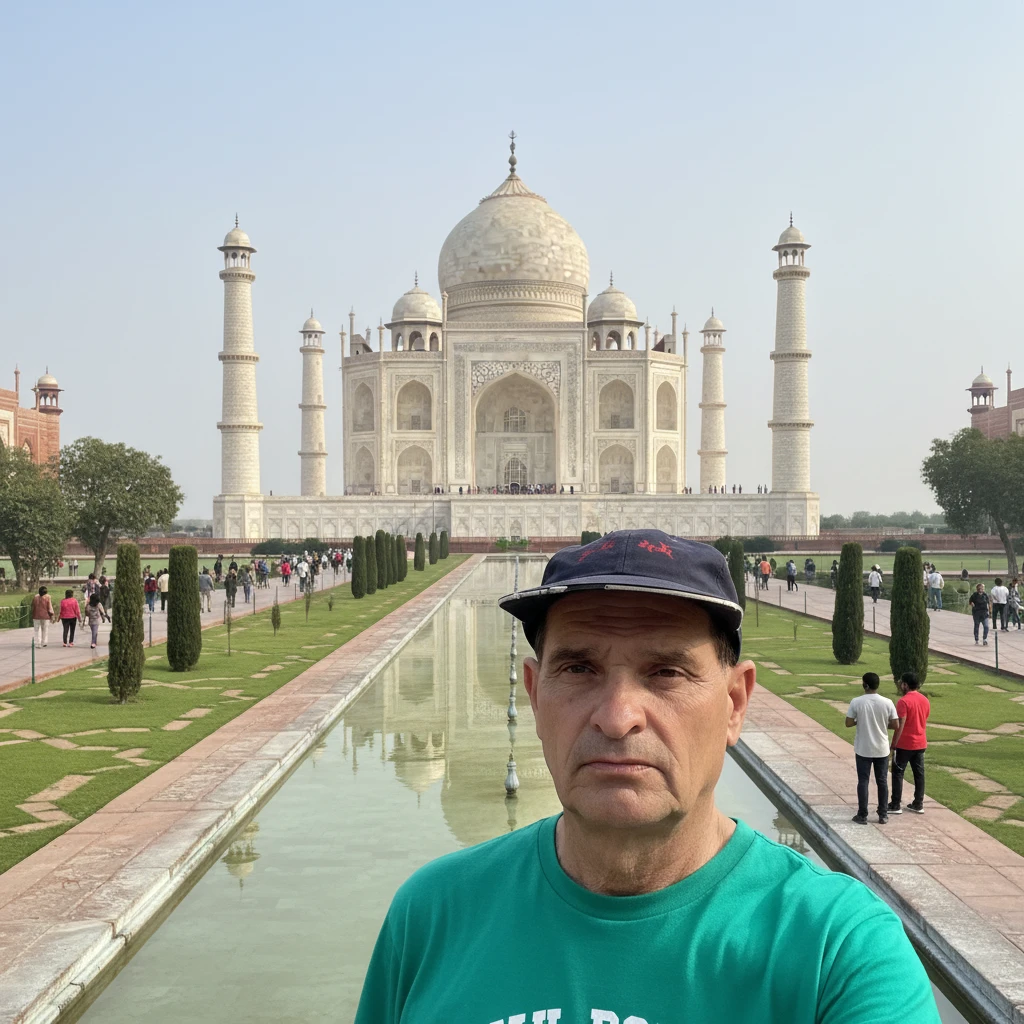
The bus ride from Allahabad took about eight hours to arrive at the ISBT Agra bus depot which is on Bhagwan Talkies Road. It is located about nine miles west of the Taj Mahal. This is the iconic site that drew me to Agra. I had no cameras with me and smart phones did not exist then so the image above was AI generated with the prompt “Place this image of me taking a selfie ( I gave Image Studio a reference photo of me) in front of the Taj Mahal.” I was afraid to walk all the way along the walkways which have a long reflecting pool of water between them. My hesitation came from the fact that there were touts here and there trying to sell trinkets. One little boy of about 10 years old was looking right at me. I looked at the Taj Mahal, I looked at the boy who was awaiting my approach, then I walked over to the grassy area where there was a bench and I sat down. No vendors followed me there. So, instead of having to navigate through the touts, I sat in the Taj Mahal gardens and had a bit of a picnic.
After I finished eating, I walked over to Taj East Gate Road and a motor rickshaw driver approached me. He wanted to take me to a hotel where I could surely find a room. I told him that I already had a room at a motel just down the street. There are several inexpensive hotels and guesthouses within easy walking distance of the Taj Mahal. I chose one on West Gate Road.
The rickshaw driver followed me and told me that he would ride me around town for shopping if I would pay him a very small price. I told him that I would buy two pairs of silk pajamas (these are not sleeping pajamas. They are Indian style pants that can be worn in public.) This made him very happy and he told me that he would charge me just a few rupees if I would let him bring me to a shop that would pay him a commission if I buy something there. He also told me that he could be my driver each day I was in Agra.
After I had the rickshaw driver bring me to the hotel where I was staying, I let him bring me to the tailor shop. The shop is a nice, small shop with a friendly tailor. He was hoping I would buy a suit but I told him I wanted only two pairs of pajama pants. After I picked out the two fabrics I wanted the pajamas to be made with, the tailor took my measurements and told me to return in two days to pick them up. We agreed that he would be my driver for the next couple of days and I told him that I am not interested in sightseeing. I was interested in neighborhoods and restaurants. If he could bring me to a nice, inexpensive restaurant now, he could join me and I would pay his meal. After the restaurant, I would just go back to the hotel and explore the neighborhood there. We could meet again the next day. By the time I finished relaxing in the restaurant, he had already left, probably hired by somebody else. I was free to wander around the West Gate Road area.
There are a few mosques in the neighborhood such as Fatehpuri and Barah Khamba masjids. Walking along outh Gate and Miyan Nazir roads, I passed a Jain Temple, post office, and a police station. On Miyan Nazir Road at Western Gate is a very good vegetarian restaurant called Guptaji Pure Vegetarian Restaurant. If you are in the Taj Mahal area and want to eat a full meal, this is an excellent place to eat. it is top rated.
Of course, I passed several Hindu Temples. I checked out Dauji Ka Temple (dedicated to Lord Balaram who is the brother of Sri Krishna) and Mankameshwar Temple. The later temple (dedicated to Shiva) is near the Agra Red Fort (not to be confused with Old Delhi Red Fort.). To arrive in this area, I walked from the Taj Mahal heading west along Agra Road which is following along the Yamuna River at this point. I very quickly arrived at Agra Red Fort and Yamuna Park. The Red Fort is very impressive and imposing. It is very much a walled town built by the Mughal Emperor Akbar. The Agra Fort Railway Station is across Gwalior Road from the grounds of The Red Fort. Mughal and Maratha rulers lived at Agra Red Fort. It is a UNESCO World Heritage Site. It was renovated by Akbar the Great when he was emperor around 1600.
The second day, I checked out of the hotel and saw the rickshaw driver waiting for me. I did not really know what to tell him because I had no real plan or destination for the day. I decided I could just walk around Agra for awhile. The rickshaw driver asked me if he could drive me around for sightseeing. I decided that it would be worth a dollar or two if I had a place to leave my duffel bag while exploring the city. He told me that he could bring me to a good but inexpensive motel where I could stay the night and my duffel bag would be safe there. I said OK, let’s do it.
After checking into that hotel, we spent a few hours visiting temples and restaurants. I am happy I trusted the rickshaw driver to bring me shopping, to stay in Agra a second night since I ordered the pajamas, and check into a second hotel so we could go sightseeing. It really was a wonderful experience. I trusted the rickshaw driver by the second day so I agreed to check into the Tourist Guest House Agra on Buddha Vihar Gwalior Road. It is a very basic Guest house. It is small and well kept with a nice patio in back. Also, I paid only about US $8.00 to stay there.
The next morning, the motor rickshaw driver was outside the hotel. This way, I would have an easy return to the tailor to pick up my silk pajamas. Everything was in good order. My order was ready. They looked very nice and I paid what we agreed. After we left the shop, the rickshaw driver brought me back to the hotel so I could check out and leave for Vrindavan. As soon as I was ready, the rickshaw driver brought me straight to the bus station. I did not eat breakfast because I wanted to get a ticket to New Delhi as soon as possible. I had to take the bus to New Delhi before catching the bus to Vrindavan.
I paid the rickshaw driver more than what he asked for because he was like a friend. He was fair with me and I never felt cheated by him. He was a nice man and seemed to like having a fairly regular customer for three days (although I was not so interested in his touristy suggestions). Our business arrangement worked out for both of us and I will always remember how I was able to get around Agra with no effort at all. He even helped me find the express bus to New Delhi and it took only one hour and forty five minutes to arrive.
The bus and train rides throughout India always went quickly for me because I was mesmerized by the scenes that went by outside the windows. So many colors, people, animals, strange modes of transportation, sounds, buildings, aromas, the fields, and the snacks all kept me busy watching India pass by, sometimes accosting me at the stations.
Indraprastha (New Delhi):
New Delhi is the capital city of India, located within the larger metropolis of Delhi in northern India, and serves as the seat of the national government.
Historically, the broader city now called Delhi has had many earlier names, including Indraprastha (due to its connection with the legend of the Pandavas as explained in the Mahabharata). In various periods and in everyday usage it has also been known as Dehli/Dehali , names often connected to the idea of a “threshold” or gateway to the Indo‑Gangetic Plain. Today, Delhi (including New Delhi) is popularly nicknamed the “City of Cities” because of its many historical urban cores, and more generally seen as a gateway city between northern and central India.
I was brought to ISBT Kashmiri Gate (Maharana Pratap Inter State Bus Terminus) in Delhi.
Here is a link to booking.com just in case you would like to explore flights and hotels. Maybe, after reading this article, you may have the urge to book a hotel in Agra:
http://www.awin1.com/awclick.php?mid=6776&idhttps://=2ee50e8b
Travel is in my blood, in my mind, and in my soul. I hope any visitors to my website will return here more than only one time because I promise to continue building it and updating it. In fact, I welcome any suggestions from readers who can help me include pertinent information that people are actually searching for. I really want to help people with this website but I am still learning. I welcome any suggestions.
MAC.
Thank you for this deeply immersive and heartfelt travel story! I loved how you captured the spirit of local hospitality—like being welcomed into that family’s home along the Ganges—and experiences such as sharing authentic meals and sleeping under the stars by the river. Your descriptions of navigating rural life and embracing local customs bring the journey vividly to life. I’d love to learn more:
When you were invited into that home after getting stuck on the beach, what moment with those hosts made you feel truly connected to their daily life?
How have these experiences shaped the way you approach future travel—especially in terms of cultural openness and embracing unplanned, meaningful encounters?
Your reflections are so inspiring—thank you for sharing such genuine stories!
Hello, thank you for the very nice comment. Unfortunately, I had no idea what I was doing when I decided to drive on the beach at Huatabampo Mexico. I drove my car onto the dry sandy strip of the beach instead of the well packed wet part. As I was trying to get my car unstuck a couple came to my aid. After we got my car away from the beach, they asked me if I could give them a ride to their home and they would make lunch for me. I accepted and accepted their offer for me to stay at their home for a few days. A few days turned into a few weeks. I first started to be connected with their daily life when they taught me how to make liquor out of ripening pineapples. They set pineapple chunks and sugar into a clay jar and let it set for about one week. When we were drinking the pineapple liquor, I was able to understand every thing they said and I was able to respond quite well. My knowledge of Spanish at that time was very basic school Spanish but at that time, a a few times after that, I spoke as a native. At least I thought I did.
I found myself staying several families due to experiences like this. I guess one experience leads to another because you become more open to it. I never actively seek out families who may invite me into their homes but I would always accept such offers because of the wonderful events and people I remember from my travels. I slept and ate in several homes while walking along the Ganga River just because the locals did not think it was safe for me to be sleeping outside. I ate some really good food during those times. And I would do it again in a heartbeat. Anyway, my response is getting a bit long so I better wrap it up. Thank you again for the great response. MAC.
The vivid descriptions of India’s sensory overload—spices hanging in the air, the hum of crowded markets—immediately transport me back. I’m struck by how the backstory frames travel not just as sightseeing, but as a full-body experience. The contrast between chaotic streets and moments of unexpected calm (like that chai stall at dawn) makes me wonder if the real magic lies in these quiet pauses between the intensity.
The detail about learning to “read” a city through its street food vendors is so true—it’s like decoding a culture bite by bite. I think these unspoken connections with local vendors reveal more about a place than any guidebook could.
Hello thank you for the comment. That was a very insightful observation. Your comment gives me confidence that I doing the right thing by including my backstories to my travel blog. I will continue on… Thanks again. MAC.
Hey thank you for this post!
And thank you for sharing this story with us, it was very well written, I can almost imagine it.
Though not any might have India on the list to visit, it does seem like an interesting trip from your experiences. There does seem to be some dangers of animals thought by the looks of it.
Thanks again and have a great day!
Hello, thank you for the comment. I appreciate anyone who can spend the time to read my longer articles. And about the cobras everybody told me about, I never saw any so I am not sure about that. I guess I can google it and find out if there really are some there. Anyway, thank you again for the comment. MAC.
Michael Cicchi’s three-month journey through North and Central India showcases the richness of India’s culture, spirituality, and history. From exploring ancient temples in Vrindavan and witnessing the rituals along the Ganga in Varanasi, to navigating cities on a tight budget and relying on the generosity of locals, the trip highlights the country’s vibrancy and warmth. His experiences illustrate that authentic cultural immersion through volunteering, homestays, festivals, and simple acts of travel is possible without spending much, making India accessible and unforgettable for travelers seeking deep, meaningful encounters.
Hello Monica Altenor, thank you for the very insightful comment. I hope the article is not to long though. I figure that anyone interested in reading it can read it in sections like chapters in a book. Anyway, thank you again for the nice comment
MAC.
Even though I have never traveled out of my home state and country, I just love to read about other places that I might experience myself one day.
I have very little knowledge of India, so your article was very interesting to me. I liked how you shared that you were on a tight budget, many of us would be on a similar budget traveling as well.
Amazing reading your article I felt like I was right there with you in India exploring all the attractions, I thank you for taking me on your travels in India.
Jeff
Hello Jeff Brown, thank you for the very nice comment. I am actually slowing down when it comes to traveling internationally. Luckily, I have been to enough places to create plenty of articles about family vacations. I will probably travel by plane a few more times but I do have to rest a couple of years. My wife thinks a couple of years just driving around SW USA would be a good idea. Anyway, thank you again for the nice comment. MAC.