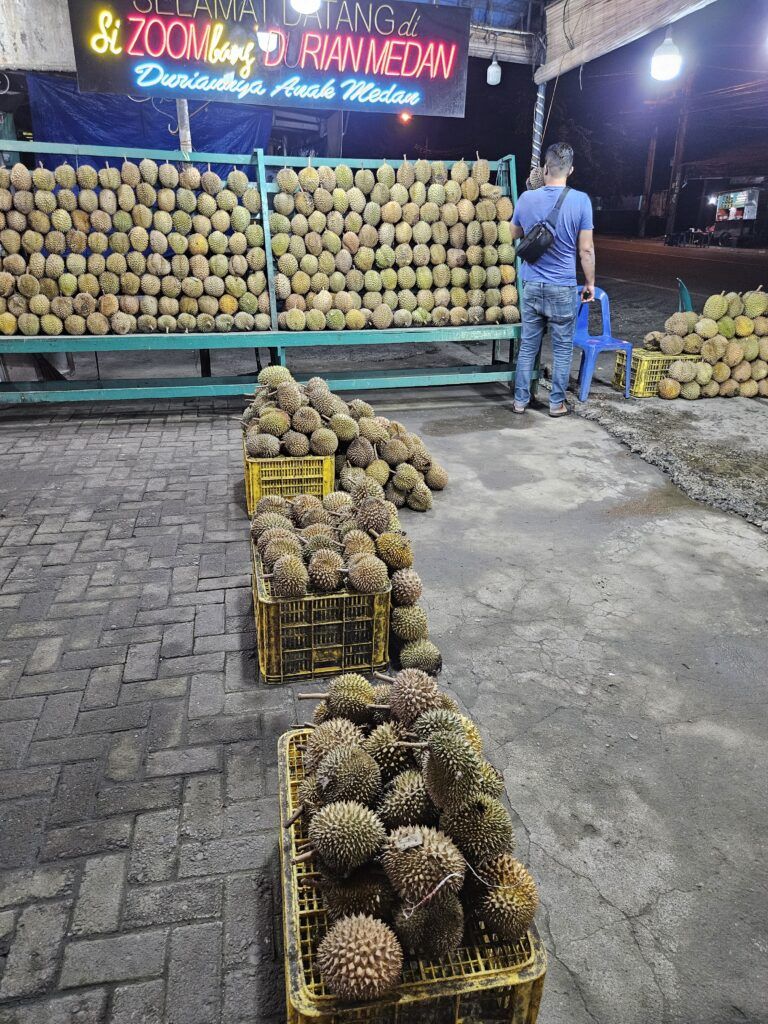
Photo below was taken at a Durian market in Medan. This is in a southern suburb of Medan.
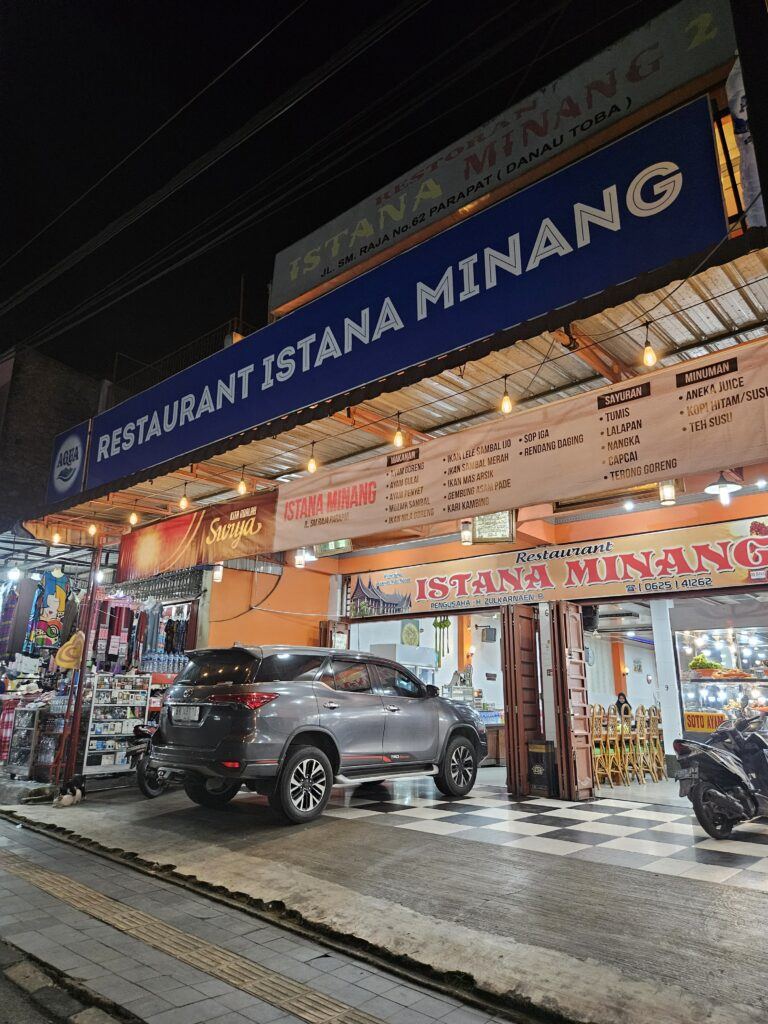
This following photo is of a typical restaurant that is large enough to seat more than 100 travelers. This restaurant is in Parapat. We ate here before returning to Medan from Parapat. This photo was taken during my last of 6 trips through North Sumatra. I have a photo of my wifes’ youngest sister at table in this restaurant. You can see the photo in my Famous Foods From Sumatra Indonesia article.
Travel smarter Wander deeply and explore the jungles of North Sumatra. That’s what I have been doing over several trips, 6 trips to be precise, after getting married in Parlilitan North Sumatra. Here is a taste of my adventures there:
Gunung Leuser National Park is a must-see for any traveler with a soft spot for nature. It is actually in the province of Aceh but just a few miles north of its border with North Sumatra. The park is not just any green space. It’s one of the last places on Earth where you can see orangutans living in the wild. Trekking through its dense forests feels like you’re stepping back in time, where every rustle and call of wildlife is a reminder of the vibrant life hidden within. It is easy to visit here and watch orangutans get fed. We drove to Gunung Leuser. It was just me and one of my brother in laws. We drove there hoping that we could find a place to sleep. We did find two single rooms in a losmen. Losmens are small motels that probably have one star or two star ratings.
We stayed there a few nights. The first full day, we took the above mentioned walk through the forest to reach the Bukit Lawang orangutan feeding platform. Our group sat in front of the platform and a call went out . Not long after the call, several orangutans swung through the trees and rested on branches where they were given bananas. The apes are endangered and they are cared for here. Some orangutans are captured when they are young but when they grow older, and much larger, the owners release them but they have a problem surviving on their own. That is why Gunung Leuser is so important. The vulnerable orangutans are cared for there and gradually released into the wild. This is actually a UNESCO World Heritage site. Besides the orangutan, there are some 750 different species of animals. It also has some 10,000 plant species including the very rare Rafflesia Arnoldi. If you visit there, you can be sure that you are visiting a location that is responsible and sensitive to the habitat and the people and animals that live there.
LAKE TOBA, LAND OF THE BATAK PEOPLE:
Lake Toba brings its own brand of magic. As the world’s largest volcanic lake and the largest lake in southeast Asia, it’s more than just a sight to behold. The lake expands like a calm, blue expanse that seems endless, surrounded by the lush hills of the Samosir Island. It’s a perfect spot to relax, swim, or simply soak in the serene landscape. Samosir Island is as big as Singapore. So that is an indication as to how huge Lake Toba (Danau Toba) is.
This region of central North Sumatra is always our stomping grounds when we visit as a family. This is where Faridas’ family is from. Farida is Batak Toba and Batak Dairi which are both people from the west Danau Toba region. When we visit North Sumatra , we need at least 2 weeks there because we have to visit family households throughout the regions of both the Batak Toba and Batak Dairi. The roads are very narrow, curvey, and often washed out. So it takes quite awhile to get from household to household. We sleep in most of the homes we visit.
One of my brother in laws has a new house they just built in a new village. There is no electricity nor plumping yet in the village. It takes almost one full day to reach the village from the last household we visit before this one. The road is not a paved road and we had to get out of our vehicle at one point to rearrange the rocks in the road so we could use them to help us push the SUV up the hill. The Indonesian government provides people really good incentives to move from populated areas (which are VERY populated in Java) to areas that are not populated. That is why Faridas’ brother built a house here. All the villagers get together to help a new comer build their new home. I think there are about 20 homes built here in this village now. It was cold staying there. We were planning on staying there two nights but the sisters (Farida has 5 sisters and 4 brothers) decided it was too cold for them so we stayed only one night. Next time we visit the village we will stay longer because there will be electricity by that time. Fish is caught fresh and many fruits, vegetables, and coffee are grown in the area. So it is well worth the stay there. The road will be improved and electricity poles are already being brought in.
Nestled in a corner waiting to dazzle you is Sipiso-Piso Waterfall, one of the tallest waterfalls of all Indonesia. The waterfall cascades dramatically into the jungle-covered valley below. Its water is plummeting down from an underground river emerging from a cave near the top edge of the Lake Toba caldera, a sight that leaves you in awe, a quick reminder of nature’s raw power and beauty. Hear the thunderous roar as you approach—it’s the sound of adventure calling. The path down to the waterfall is lengthy but easy to accomplish and it takes less than an hour. We visited Sipiso-Piso Waterfall on the way back to Medan after a 10 day excursion to all of the households in Faridas’ family. We had to take a more narrow road between Parlilitan and Medan rather than the trans Sumatra highway that passes through the tourist towns of Parapat and Balige. The highway that 95% of tourists will see is the Jalan Lintas Sumatera that runs from Medan to the south of Sumatra through Parapat, Balige, Padang Sidempuan and Bukitinggi. It runs along the south side of Lake Toba. The road we took to reach Sipiso-Piso Waterfall runs along the north side of the lake, through Berastagi and Merek. It will cost about 10,000 rupiah for entrance and parking which amounts to about US 75 cents.
For those who love a good hike, Berastagi offers trails with stunning rewards. Mount Sibayak and Mount Sinabung provide challenges for those wanting a bit of adventure. The trails can be a bit tough, but the view from the top is totally worth it. It’s an opportunity to connect deeply with the great outdoors and find a bit of peace amidst the chatter of modern life. There are 5 different Batak people. My wife is Batak Dairi and Batak Toba. Berastagi is in Batak Karo territory which is on the east side of Lake Toba. It is in the area of the Barisan mountain range with the 2 volcanoes within walking distance. We visited Berastagi during two trips through North Sumatra. The first time we visited was for the cool temperatures and to climb Sibayak, a stratovolcano. This was a successful visit. The second time we visited Berastagi, it was for the cool temperatures and to climb the Volcano Sinabung. This visit was not as successful because Volcano (gunun api) Sinabung had been erupting since our last visit so no climbing was allowed that year. We decided to climb Volcano Sibayak again. It was not too upsetting though, because we climbed up using a different path. Oh, there is a tiny fee of 10,000 rupiah to climb Sibayak which is about US 75 cents.
What else does Berastagi have? Well, it has an amazing fruit and vegetable market. If you visit only one fruit and vegetable market in the world, THIS is the one to visit. The products taken from the ground are not only multifarious, but also of extremely large size. I have never seen onions and carrots even close to the size that they grow here. There are also rabbits and a large amount of flowers sold right next the fruits and vegetables. That is about it for the attractions for tourists in Berastagi. Although it is not a tourist haven, it really should be visited for the weather (it is some 4,200 feet in elevation which is about 1,300 meters), the two volcanoes, and the market. It is a wonderful place to relax with many very inexpensive hotels and losmen for overnight stays with quite a few restaurants.
The Batak culture is deeply embedded in North Sumatra’s identity. Known for its vibrant music, elaborate dance, and striking architecture, exploring Batak traditions offers a glimpse into a rich heritage that has thrived for centuries. Visitors can witness these traditions in local villages around Lake Toba, where community life centers around these cultural expressions. Christianity has a strong foothold in the Batak Toba and Batak Dairi cultures thanks to Dutch missionaries who started to arrive in the area around 1850. . The other three Batak populations are almost exclusively Muslim. My first introduction to the Batak people was on a public bus from Medan to Parapat. His name was Rikson and he was on his way to Si-muara which is on a mountain over looking the south shore of Lake Toba where the small village of Muara is located. He asked me to join him so I could visit his family through Christmas week. I accepted. They do not celebrate Christmas only one day a year; it is a week long celebration. I could write books about my experiences here because this is where I got married and lived several times for 2 months at a time. Maybe I will write several articles here about various aspects of life in North Sumatra.
Leaving the central highlands of North Sumatra, we return to the east side of Sumatra. Medan is a city of more than 2,000,000 residents. It had that many residents when I first arrived there. It has grown quite a bit since then. My first flight into Medan was into Polonia Airport which was in a southern suburb of Medan. I would actually walk past the several touts trying to give me rides, out to the street leading north past a large mosque (Masjid Agung Kota Medan) to Jalan KH. Zainul Arifin. I would then turn left and walk to our house there, about three miles northwest of downtown Medan. I could never do that now because there is a new airport about 20 miles (or about 26 kilometers) from Medan; Kualanamu International Airport.
Medan’s Grand Mosque (Masjid Raya Al Mashun) stands as a testament to North Sumatra’s architectural and cultural diversity. The mosque is not just a place of worship; it’s an architectural marvel with its ornate domes and stunning interior. Walking through its halls, you get a sense of the region’s multicultural backdrop and religious harmony. It was built around 1785. Its architecture is influenced by Middle Eastern, Spanish, and Indian styles. It really is magnificent and anyone can take strolls through the mosque for no charge. It has Islamic wall hangings, large marble chandelier, and large stained glass windows.
Vihara Gunung Timur, the largest Chinese temple in Sumatra, opens doors to spiritual discovery. It’s a place where peace pervades, offering visitors a serene escape from the city’s hustle. Here, colors and incense combine to create an atmosphere ripe with spiritual vibrancy. Whether you’re here to meditate or simply admire, the experience is both calming and enriching. This temple was built in 1962 not too far from another temple; the Hindu Sri Mariamman Mandir and the previously mentioned Masjid Agung. I’ve spent some time here, just relaxing and enjoying the incense wafting thickly in the temple room. There are several altars and something like 80 deities depicted. There is a Buddhist area with Maitreya Buddha and Quan Yin amongst others I do not recognize. The Taoist area has many deities I do not know. I wrote down the name of Pek Ho Kong so I could google him. His murti is very intriguing. He is White Tiger of the West. He represents the western direction of the Chinese constellations.
North Sumatra’s markets are a living museum of culture where the chatter and exchange breathe life into tradition. It’s at places like Medan’s Pasar Rame that you truly feel the pulse of local life. Exploring these markets isn’t just about shopping but discovering the authentic flavors and sounds of this dynamic region. It’s where tradition and daily life seamlessly intersect. My first few visits to such markets, I felt kinda bad because I was afraid to buy any fruits or vegetables. I was afraid they would charge me twice as much as they would charge the locals. And most likely that would be true. Once I met Rikson, and especially Farida, I was able to buy many fruits and vegetables through them. Fortunately, all such markets do have food stalls where prices are set. Pasar Rame, for example, has a Sate Padang food stall. Sate Padang is absolutely not to be missed. 2,500-25,000 rupiah will get you some excellent, traditional sate skewers and meals. This amounts to a few cents USA to just a couple of dollars.
A Culinary Adventure: Savoring North Sumatra’s Delights
Sumatran dishes are a feast for the senses, showcasing bold flavors and vibrant spices. Rendang, a slow-cooked beef dish, is famously rich with an intricate blend of coconut milk and spices. Arsik, a spicy fish stew, comes straight from Batak culinary traditions and is a must-try when you’re in the region. These dishes offer an authentic taste of Sumatra’s diverse communities. Rendang is absolutely amazing. The thing is, I do not eat beef or pork but I have eaten beef dishes twice in the last 15 years or so. Once in Paris, I just had to try their famous Beef Bourguignon. The other time was in Sumatra when I just had to try Rendang. I am not sorry that I digressed from my dietary choices during those two occasions because both dishes are amazingly delicious and unforgettable. I cannot begin to list all the wonderful foods found in Sumatra unless I create a whole article about it. FLASH, I will create a whole article about the foods of Indonesia; stay tuned.
North Sumatra is also a paradise for coffee enthusiasts. Mandailing Natal stands out as a coffee-producing area where visitors can follow the journey from bean to cup. Sampling a freshly brewed cup of Mandailing coffee is an experience that stimulates not just the palate but also connects you with the local soil and climate that shape its unique taste. Faridas’ family also produces coffee beans on a plot of land near a new village where one of her brothers built the house I mentioned above. The coffee is wonderful. We drink it in glasses, either black with lots of sugar or with milk (coffee susu.). The family grows, cultivates, processes, and brews their own coffee thanks the the perfect coffee growing conditions of North Sumatra near the border with Aceh. The volcanic soil probably has something to do with it.
Street food in Medan is a thrilling culinary journey. Vendors tempt you with a variety of snacks from satay to martabak. Each bite tells a story of North Sumatra’s cultural tapestry. Exploring these street eats offers a more casual way to taste the tropical flavors that characterize the region. In this case, I can make a small list because, although there are probably a few dozen famous street foods with several variations of each, I do have my favorites that I have to eat every visit to Sumatra. Ayam Soto is a soup with chicken, turmeric, lemongrass, and ginger. In Medan the Soto will also have coconut milk. Nasi Padang is steamed rice with spicy hot curries, with vegetables, beef, or fish. Es Campur is a dessert which is extremely refreshing. The name means mixed ice and it comes in a crazy amount of varieties. Agar-agar (of several different colors), condensed milk, melons, lychees, jackfruit, mango, and other fruits can be included. There are many other street foods I just cannot include here so I can include them in my new article about the best foods of Sumatra.
For those who value fresh ingredients, North Sumatra’s local dining spots often incorporate farm-to-table practices. Meals are prepared with ingredients sourced right from the local area, assuring freshness and sustainability. Dining here supports local farmers while giving your taste buds a treat. Places with traditional meals that have very high ratings are Marugame Udon at Sun Plaza in Medan, Restoran Sari Raso in Kota Padang, and a place we always go to while in Medan called Garuda Restaurant. This is a Nasi Padang restaurant with extremely reasonable prices. Merdeka Walk is also in Medan and it includes many food stalls and restaurants representing many styles of Indonesian cooking.
Practical Travel Tips for Navigating North Sumatra
Timing is everything when visiting North Sumatra. The region is best explored during the dry season between April and October when the weather is more agreeable and travel conditions are favorable. This offers a great chance to enjoy outdoor attractions without the interruption of heavy rains. The year I returned to Indonesia to get married, I took a ferry from Kuala Lumpur Malaysia to Dumai Indonesia. From Dumai, I boarded a bus to Pekanbaru. After one day of exploring Pekanbaru, I boarded a bus to Padang Sidempuan where Farida was working. Half way to Padang Sidempuan, the bus got bogged down in the rain. Yes, I had arrived about one month into the rainy season. I was stuck in this really small village with nothing to do but worry about Farida since there was no way for me to contact her as to where I was and why. It was the rainy season and cell phones had not been invented yet.
Getting around North Sumatra might seem daunting, but understanding local transport can make it easier. Public transportation options like becaks (motorized rickshaws) and angkot (shared minibuses) offer affordable ways to navigate busy areas. Renting a car or scooter can provide more flexibility, especially if you’re keen to explore remote spots. The mini buses are really convenient because there are hundreds of the buggers running the routes in the larger cities. They also run between cities; town to town until the destination is reached. In such cases you pay the fare then ride to your final destination. In the cities, you get into the angkot ride to your destination, then pay the change you owe. And yes, it is just change.
Packing smart is key. Essential items include lightweight clothing, a reusable water bottle, and good walking shoes. A light raincoat or umbrella is handy since surprise showers are not uncommon. Insect repellent and sun protection are must-haves, especially during outdoor explorations. The first couple of years I traveled to Indonesia, malaria was a concern but the last three or four visits gave us no indication that malaria would be a problem. Information about any disease danger in Sumatra can be found online; World Health Organization and Global Disease Burden By Region keep up to date on these matters.
Engage with locals respectfully by familiarizing yourself with some basic conversation in Bahasa Indonesia and understanding local customs. Simple gestures like using your right hand to give or receive items go a long way in showing respect. While generally safe, being aware of your surroundings and keeping personal items secure ensures a hassle-free experience. I have never had any problems with any kind of crime.
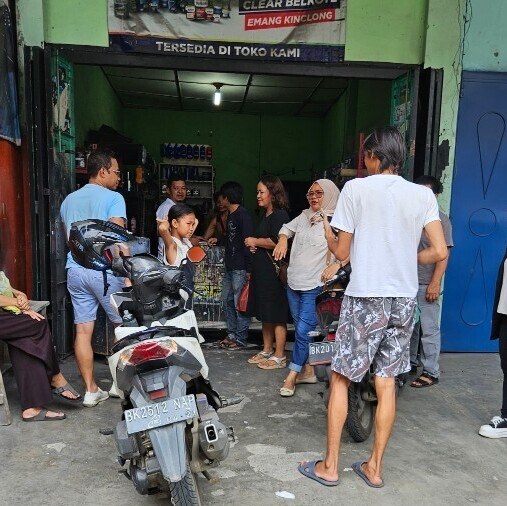
This above photo was taken at the house of Edo in Medan which is on the eastern side of North Sumatra. He lives above his automobile paint shop.
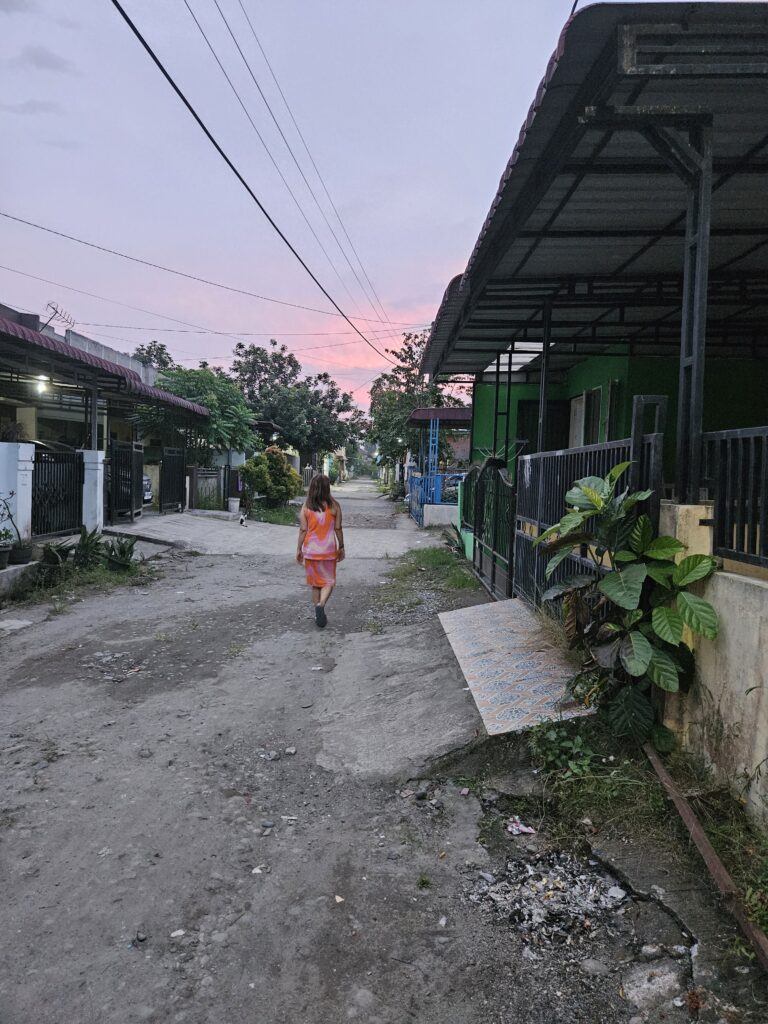
The following photo is in a suburb of Medan. One of Faridas’ family members lives in this neighborhood.
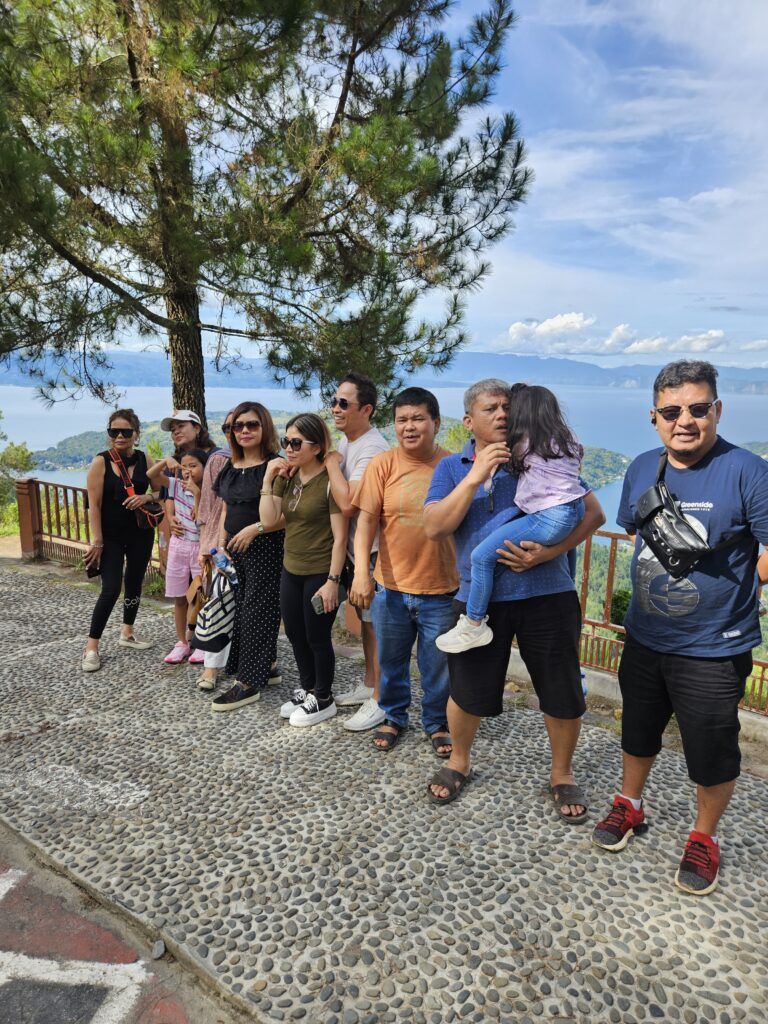
The following photo is at a west side viewpoint of Lake Toba. This is Faridas’ family with the husbands of 2 sisters. Faridas’ oldest sister is not here because she was not traveling with us.
Anita Desai said:
“Wherever you go becomes a part of you somehow.”
Here is a link to www.booking.com that you can click on just in case you got the sudden urge to go get lost in Sumatra. Actually, you can go explore any place in the world with booking.com with plane and hotel bookings immediately or in the future. I think bookings can be made 10 to 11 months in advance although I prefer making my reservations about four months in advance. That is just my habit and preference. Anyway, feel free to click on the link if you feel like exploring the booking.com website:
http://www.awin1.com/awclick.php?mid=6776&idhttps://=2ee50e8b
Here is a FAQ section about interesting places to visit while traveling across North Sumatra:
What are the must-see highlights in North Sumatra?
The main highlights most travelers prioritize are Lake Toba and Samosir Island, Gunung Leuser National Park (Bukit Lawang and Tangkahan area), Berastagi with its volcanoes, and the cultural and culinary hub of Medan. Many travelers link these into an overland loop starting and ending in Medan.
Why is Lake Toba so famous?
Lake Toba is one of the world’s largest volcanic lakes, formed in the caldera of an ancient supervolcano. In the middle lies Samosir Island, known for traditional Batak villages, distinctive boat-shaped houses (rumah adat), and relaxed lakeside guesthouses
What can I do around Lake Toba and Samosir Island?
Common activities include renting a scooter or bicycle to circle parts of Samosir, visiting Batak cultural sites and traditional dance performances, and swimming or kayaking in the lake’s clear, cool water. There are also viewpoints and small waterfalls around the caldera rim for short hikes and photo stops.
Where can I see orangutans in the wild?
Gunung Leuser National Park, especially around Bukit Lawang, is one of the most accessible places on Earth to see semi-wild and wild Sumatran orangutans. Treks range from a few hours to multi-day hikes that may also reveal gibbons, macaques, hornbills, and rich rainforest flora. We booked a tour here with a very small tour group to the Orangutan Rehabilitation Center where we could watch the tour guides call out to the orangutans. A few orangutans would swing out of the forest from tree to tree until reaching a platform where they can eat bananas.
What is special about Tangkahan?
Tangkahan is a quieter jungle outpost on the edge of Gunung Leuser, reached by rougher roads and known for rivers, hot springs, and suspension bridges. Travelers go there for tubing, river swimming, and a more off-the-beaten-track rainforest experience compared with Bukit Lawang.
Is Berastagi worth a stop?
Yes. Berastagi is a cool highland town popular for its fruit markets, views of surrounding volcanoes, and as a base to hike Mount Sibayak. The area offers sunrise hikes to steaming craters, nearby hot springs, and viewpoints over farmland and peaks.
What is Mount Sibayak like for hikers?
Mount Sibayak is considered a relatively accessible volcano trek, often done as a half-day or sunrise hike from Berastagi. At the summit, hikers typically find fumaroles, sulfur-stained rock, and broad views, sometimes including neighboring Mount Sinabung in the distance.
Are there impressive waterfalls in North Sumatra?
Sipiso-piso Waterfall, near the northern rim of Lake Toba, is one of Sumatra’s best-known falls, plunging around 120 meters from a high plateau into a gorge connected to Lake Toba. There are viewpoints near the parking area and a long staircase for those who want to descend closer to the base. I. once filmed our descent all the way down to the pool of the waterfall but I cannot include the video because it has been lost to time. It is now dust in the winds of history.
Is Medan just a transit city, or should I explore it?
While many travelers treat Medan mainly as a transport hub, the city has several cultural and historical sites worth a short stay. Highlights commonly mentioned include the State Museum of North Sumatra, Maimoon (Maimun) Palace, Tjong A Fie Mansion, Graha Maria Annai Velangkanni church, and lively local food scenes.
Are there quieter or more offbeat places beyond the main circuit?
Outside the classic Medan–Bukit Lawang–Berastagi–Lake Toba loop, travelers sometimes add destinations like the west-coast island of Nias for surfing and beach time, or remote valleys and highlands in West Sumatra such as Harau or Sianok (though these fall outside the administrative province of North Sumatra). These require more travel time but reward visitors with fewer crowds.
How long should I plan to explore North Sumatra?
A compact trip focusing on Lake Toba and orangutan trekking can fit into about 5–7 days. For a more relaxed overland journey including Bukit Lawang, Tangkahan, Berastagi, and Lake Toba, many travelers allow 10–14 days. We always spend at least 14 days traveling through North Sumatra but we are there to visit family households besides whatever sightseeing we are doing. MAC.
Wow, what a beautifully detailed account of North Sumatra! I feel like I was trekking through Gunung Leuser and sitting on the orangutan feeding platform right alongside you. The way you weave together natural wonders like Lake Toba and Sipiso-Piso Waterfall with personal family experiences really makes the region come alive. You made me want to plan a visit just to experience that week-long Christmas celebration!
When you visited the markets in Medan, did you find any particular local dish or ingredient that completely surprised you or that you haven’t seen outside North Sumatra? Also, how do the volcanic soils around Lake Toba influence the coffee and crops you mentioned? I’d love to learn more about that connection between the land and the local cuisine.
Hello, thank you for the comment. I t was very nice. Oh man I could write for hours about the local spices like galangal (similar to ginger but more mild) or ketcup sedang (a semi sweet and very thick soy sauce) and local dishes but I will do the hard part and keep it short. Some of my favorite foods in Sumatra are foods I always long for when I am not there. They are found only in the small eateries and food stalls of Indonesia. There is Longton, Bakwa, Lemak, Rujak, and others that I love to eat but these, along with Gado-Gado are the foods I always crave when not in Sumatra. My wife CAN cook up some of these here in USA but they do not come out exactly the same. I can not even find ketcup sedang here in Albuquerque.
Oh, and the volcanic soil around Berastagi is really rich with minerals because of ancient eruptions and the recent eruptions of Gunun Sinabung. The soil around Berastagi has a large amount of volcanic ash which adds many minerals that enrich the soil.The volcano Sinabung continues to erupt so it continues to add such minerals like phosphorus. I asked ChatGPT how much this soil affects the growth of the huge carrots and onions I have seen there and it told me; that the soil content boosts; “growth of crops such as potatoes by up to 68%…” Anyway, my response is getting a bit long so I better sign out for now, thank you again for the very nIce comment.MAC.
What an incredible read! I really enjoyed how you captured both the wild side of Gunung Leuser and the peaceful beauty of Lake Toba—it feels like two totally different adventures within one journey. The way you described the orangutans made it easy to imagine being right there on the trail. Do you think Lake Toba is better suited for a few days of slow travel, or more of a quick stop along the way? And for Gunung Leuser, would you recommend going with a guide, or is it manageable for independent travelers?
Hello, thank you for this very nice comment. I absolutely recommend staying in the Lake Toba area for several days. Stay on Samosir Island for a couple of days because there is so much to explore there and hiking is terrific. There is not much to do in Parapat but it does have some nice hotels and restaurants. The Niagara Resort is here and it is nicest hotel on Sumatra; an all inclusive resort high on a mountain over looking Parapat and Lake Toba.
As for Gunung Leuser, we always go to Bukit Lawang without any reservations and then find rooms without any problem. This is not a busy place as far as tourists are concerned. Most tourists are regional. It is consequently easy to arrange for hikes into the forest to meet the orangutans. The hotel you stay at most likely can help arrange it or you could go to one of several tour guide operators who will arrange it for the same day or next day. We’ve been there twice and both times we had our tours arranged right away and the groups were quite small. Anyway, thank you again for the nice comment. MAC.
Gunung Leuser National Park is, without a doubt, one of the most compelling highlights of this narrative. The section describing the orangutan feeding platform was especially moving. Sitting quietly in the forest, waiting for these incredible creatures to appear, must have felt surreal. The description of them swinging through the trees and gently accepting bananas paints a vivid picture of both their majesty and vulnerability. Knowing that these orangutans are rescued and rehabilitated adds a profound layer of importance to the visit it’s not just a trek, it’s witnessing conservation in action. How many of the orangutans have successfully transitioned into full independence? And is the park seeing increased support from ecotourism in recent years?
Hello Ravin, thank you for this nice comment, sorry it took me awhile to answer but I was busy wracking my brain trying to start up a second website. Anyway, absolutely, Gunung Leuser is one of my favorite places to visit in Sumatra and we will be going there again next time we return to Sumatra. The Orangutan Conservation Center has certainly been very active in preserving the natural habitat of the beautiful apes (they are my favorite animal). Illegal residents within they park have lately been relocated outside of the park and this continues to be of great importance for the Indonesian government. There are other efforts keeping the government busy rescuing orangutans that have been trapped to be sold as pets. There are something like 11,000 orangutans living at Gunung Leuser right now.
Most of those 11,000 orangutans eventually roam further out into the wilds of the North Sumatra and Ache mountain ranges to full independence. There are also something like 150 Sumatran Tigers that are presently being protected in the region. I did not see any of them though! It truely is a wonderful place and I cannot wait to get back there. Anyway, thank you again for the very nice comment MAC.
Thanks for sharing an informative article
Your writing gives a warm, personal, and immersive view of North Sumatra, combining vivid travel details with your deep connection to Batak culture and family life. It feels authentic because you describe the region not as a tourist, but as someone who has lived it, its landscapes, food, long journeys, and everyday moments. Overall, it reads like a heartfelt, genuine snapshot of a place that has become part of your life.
Keep up the good work!
WOW, your comment is really beautiful. Thank you very much. Yes, North Sumatra’s definitely part of my life since I got married there and promised to bring Farida back to her family every 5 years ( which became once every 7th year because of the COVID situation). Anyway, thank you again for the great comment..AC
Michael, this was an interesting read. What stood out to me is that you had a real travel experience—not just sightseeing, but truly experiencing the food, people, culture, and daily life. That adds depth, and it’s something many travel articles miss.
I liked how you balanced major landmarks like Lake Toba and Gunung Leuser with local details such as markets, food stalls, and village life. In my opinion, that’s what makes travel meaningful—when travelers actually see how people live, not just focus on attractions. This post makes North Sumatra feel authentic and accessible, encouraging visitors to explore beyond the usual tourist routes.
Hello Mohamed, thank you very much for the great comment. Yes, Sumatra IS quite accessible and very inexpensive. It a bit more chaotic than most asian destinations but is so much fun. I am thinking I may retire there someday and become a private tour guide. We shall see. Thank you again for the nice comment. MAC.