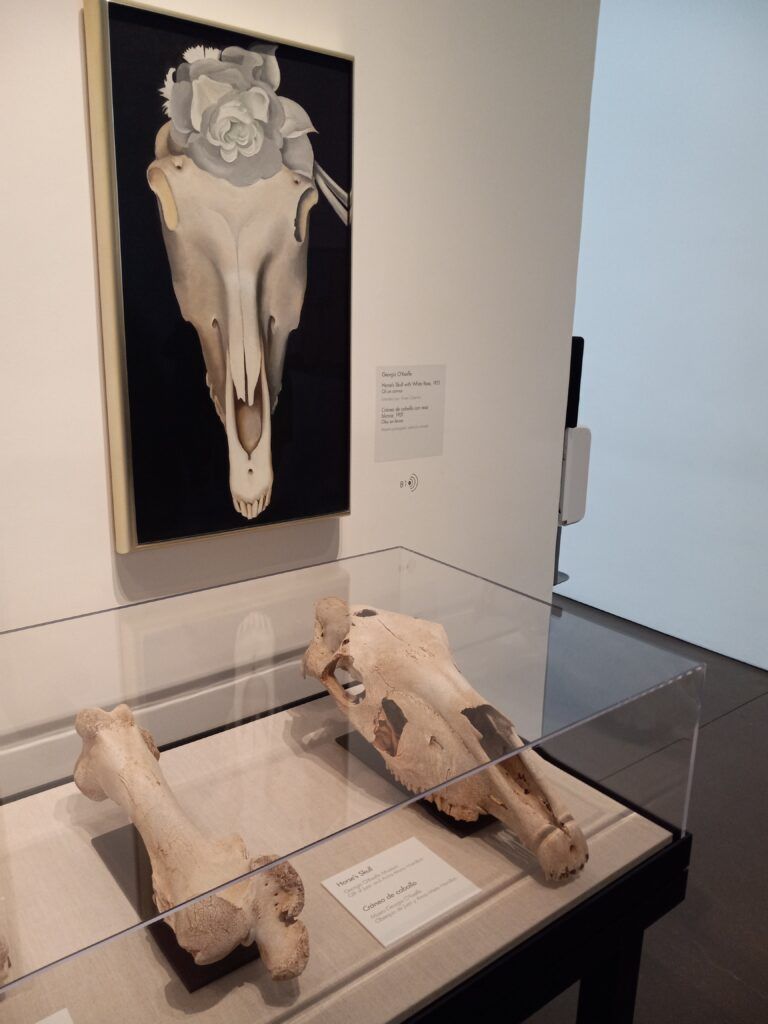
This photo was taken at the Georgia O’Keefe Museum.
I was working in a restaurant in Santa Fe New Mexico. I was living in a conversion van that had a bed. After two years, I met a married couple who were living and traveling in a 1967 Ford short model school bus. We were talking about life on the road and they offered to trade with me their bus for my van. They said …”we are ready to get off the road and settle down.” I agreed to the trade and it was not long before I was on the road. I told the restaurant that I would like to take a road trip and return to the restaurant afterwards. They assured me that I would have a job again whenever I returned. The trip took me 1 year and three months to complete. The following is a description of my 1 year road trip:
Santa Fe stands as both a historic gem and a vibrant modern city. Wandering its streets, you’re surrounded by adobe architecture that whispers stories of the past. The city’s Plaza offers a tapestry of culture, filled with art galleries and bustling markets. Take your time to explore the artistic masterpieces at the Georgia O’Keeffe Museum; there’s local history etched into every wall. Two of the oldest churches in the USA are located in Santa Fe. On the Old Town Plaza, you will see native American artists selling their products there. This city is full of artist studios and galleries. I love Santa Fe but I had the itch to hit the road so I did.
As you hit Highway I-25, the vastness of New Mexico’s deserts-cape sprawls out before you. Mesas rise dramatically from the earth, creating a rugged skyline against the endless blue sky. These landscapes, though often quiet, hold a captivating beauty especially during the golden hours of dawn and dusk. I-25 curves towards the east through Las Vegas NM then north through Wagon Wheel up to Ratón. I stopped in Ratón to relax and get a snack. I like this town so I always stop here before climbing the mountain into Colorado. Ratón is a town of around 6,100 people. Tom W. Blackburn came from here. Yea, I know, just google his name.
After about one hour at a diner here and filling up with gas (thinking it may be more expensive in Colorado), I headed north slowly climbing Ratón pass. Ratón is only about 7 miles from Colorado but it takes quite a while for an old 1967 school bus to climb the mountain. Historically, it was the mountain trail of the Old Santa Fe Trail and it is listed as a National Historic Landmark. Ratón is on the south end of Ratón Pass and Trinidad Colorado is on the north end. Its elevation is 7, 834 feet or 2,388 meters so, yes, my poor bus did have a tough climb but she made it.
Thus, I did make it to Trinidad Colorado. The population of Trinidad is almost 9,000 residents. The Purgatoire River runs through it. It has a lot of Victorian architecture and red brick streets. The town was founded in 1862 and has the Trinidad History Museum. It was even called the “sex change capital of the world” because there was a doctor Stanley Biber who was performing four sex change operations daily. What the heck? I just hope his clients are all OK because I would think such an operation would take a whole day to be accomplished. Well, I am not a surgeon so what do I know?
Trinidad has many very good restaurants but the restaurant where we always ate no longer exists. I do not know why because it was wonderful. They still have Way Out West Coffee Co. as well as Park Cafe and Trinidad Smokehouse which are all very good.
Tracing Peaks and Plains: From Colorado to Cheyenne, WY
Venture into Colorado where the Rocky Mountains paint an unforgettable backdrop. As you move from Pueblo to Denver, the majesty of jagged peaks and lush valleys greets you at every turn. This leg of the journey is a photographer’s dream, offering countless opportunities to capture nature at its finest. From Trinidad to Pueblo, the landscape is quite flat, passing Walsemburg where my moms’ mom is from, then up past Pueblo, the Rockies will start to appear on your left. Then you have Cheyenne Mountain (with Norad underneath it) and Colorado Springs just in front of you.
Colorado Springs is a mid size city with about 480,000 residents. It is my home town. I never visited my home town as a tourist until 2019. So, on this across the country journey, I stopped here only to visit an old friend. Her name is Dessa and she has lived in the Colorado Springs and Florence Colorado area all her life. We traveled together into Old Mexico (throughout Sinaloa) for a one month driving trip. We also traveled to Las Vegas NV together. For this trip, though, she would not be joining me. She did join me for a few meals at our favorite places to eat. Dale Street Cafe and Poor Richards’ are both of our favorite restaurants. After visiting my home town for a couple of days, I moved on, heading north past Castle Rock to Denver.
Denver, Colorado’s capital, weaves the charm of a bustling metropolis with easygoing mountain vibes. This is known as The Mile High City. Dive into the vibrant arts scene, from the Denver Art Museum‘s captivating exhibits to eclectic street art. The museum has an excellent display of Western American Art, Native American Art, and pre-Columbian artifacts. For street art a good location is East Colfax Steet with its several murals. Go to Colfax at York and at High Street. There are also; The Art District on Santa Fe, Confluence Park, and South Broadway.
Also, with countless breweries, Denver’s craft beer experience is not to be missed. There are something like 20 breweries in Denver Downtown Denver has at least four breweries. For those who are fans of Coors Beer, their mothership brewery is just an hours drive west into the Rockies. It is in Golden Colorado.
Take a stroll through the historic districts, where the past meets the present seamlessly. The oldest neighborhood is LowerDowntown. It has historic buildings from around 1850. Five Points has a rich history of African American culture and jazz clubs. Larimer Square has the first commercial district with plenty of Victorian architecture.
When I lived in Denver, I lived at the ISKCON Temple at 1400 Cherry Street. It is called New Badarikasrama.I lived there for about 6 months until I went to India ( see; Experiences Of India. Backstory #3. ) So, on this trip, when I arrived into Denver, this was where I visited, staying in my bus just outside the Temple. They have a great restaurant here and that is where I ate each day. I stayed here for about one week.
Heading north, the landscapes evolve as you reach Northern Colorado. Here, the plains stretch wide, dotted with charming small towns and rich wildlife preserves. Fill your days with hikes or wildlife spotting in areas like the Pawnee National Grassland, where peace and natural beauty reign supreme. This is in the South Platte River Basin, between Greeley and Sterling. It has really cool Buttes there called the Pawnee Buttes. There are a few camping sites and hiking trails here, including the buttes. Anyway, I visited this area for a few hours and then continued north.
Arriving in Cheyenne, Wyoming, brings a shift to western spirit and open skies. Known for its rodeo culture, Cheyenne is a hub of cowboy heritage and hospitality. Explore landmarks like the Cheyenne Depot Museum or simply wander downtown enjoying the local shops and restaurants. The Steam Shop that houses Big Boy #4014 Steam Engine is here. This engine was part of the Union Pacific locomotive fleet. There are only eight of these engines still in existence and this is the only one that is still operational. To see this, you must book a tour and the tickets are $42.50 which includes the Depot Museum, the Steam Shop and a Cheyenne Street Railway Trolly ride between the two. This is a great reason to hang out in Cheyenne and it is a great example of how this city captures the essence of the West, making it a delightful stop on this road trip. Durbar Indian and Nepalese Bistro and Napolis’ Italian Restaurant are great budget friendly places to eat in Cheyenne.
Fields of Gold and Grand Horizons: Interstate 80 Across Nebraska and Iowa
The drive through Nebraska is a journey into the heart of the American plains. As you cruise along Interstate 80, the fields of gold stretch endlessly, a vast sea of cornfields under the wide-open sky. It’s the kind of landscape that exudes tranquility, inviting you to roll down the windows and enjoy the fresh Midwestern air. Highway 80 stretches from San Francisco California to Teaneck New Jersey. East of Wyoming, this highway is a straight shot through Nebraska. Normally, this would be a rather uneventful drive but I did have my adventure here. I made a bit of a detour north to the Rosebud and Pine Ridge Reservations. I did this because I picked up a mother and son who were hitch-hiking on the Highway. They were Native Americans and they live on one of those reservations. I am not sure which reservation I dropped them off at. These two reservations are right next to each other, The mom and son wanted me to bring them all the way to their home but I would not. I was afraid that if I did that, I would be stuck for a few days there if not longer. I brought them to the first house we came to. They tried to get me to take them further but I still parked at that first house. After about 10 minutes, the son had to take a leak so he got out and went to the house. The residents let him in. The mom stayed in my bus but finally, after asking where her son was, I told her he was in the house. She then got out and went up to the house at which time I was able to turn around and drive back to Interstate 80.
In Omaha, Nebraska‘s largest city, there’s a vibrant blend of old-world charm and modern flair. Omaha is on the Missouri River west bank with Council Bluffs Iowa on the east bank. The historic Old Market Area is a must-see, with its brick-paved streets and bustling cultural scene. This area encompasses about nine square blocks of downtown Omaha. Restaurants, boutique shops, and museums are located in and around this area that has covered walkways, street performers, brick roads, and horse carriages. Stop by the Durham Museum to delve into the region’s rich history, then take a leisurely stroll along the beautiful riverside paths. The museum is CLOSED ON MONDAYS. I closes by 1600 each day. Tickets are $15.00 and $12 for seniors. I think its prize artifact is a pocket watch found in the Titanic shipwreck.
Continuing into Iowa, the landscape slowly transitions into rolling hills and fertile farmland. Iowa’s vistas offer a picturesque backdrop, with rustic barns and silos dotting the countryside. It’s not uncommon to see deer grazing at the field’s edge as you drive through this serene landscape. The drive really is through hill after hill after hill. I remember mostly, besides all the hills, a whole lot of corn fields but there also a lot of soybean and hog and cow ranches. I also know that there are some 50,000 honey bee colonies in the state. If there are 50,000 bee colonies, how many bees is that? Amazingly, I did not get stung by any bees. 😃🐝
Des Moines, tucked within Iowa’s heartland, boasts a surprising depth of culture and cuisine. The East Village neighborhood is a highlight with its artisan shops and trendy eateries. East Village is close to Downtown Des Moines. The state capitol building and some National Register of Historic Places buildings are here. Downtown also has Pappajohn Sculpture Park and a Science Center. Basil Prosperi is a great, mid range restaurant in the downtown area. It has lots of Italian dishes. Explore the city’s many parks and gardens, or delve into art at the Des Moines Art Center. This is a museum and an art school. It has existed since 1948. The city’s friendly vibe and welcoming neighborhoods will leave you eager to explore more. Exploring more could bring you to Jordan Creek Town Center in West Des Moines. This is the largest shopping and entertainment center in all of Iowa. P. F. Chang (one of my favorite restaurants) is here.
After a couple days in Des Moines, it was time to drive north into Minnesota:
Land of Lakes and Mighty Rivers: Northeastern Journey from Des Moines to Hibbing
Leaving Des Moines, the journey northward into Minnesota brings us into a landscape change. Highway 35 is your gateway to lush greenery and the start of the land known for its countless lakes. Rolling through these scenic terrains with forests of thousands of tall tees, you’ll find tranquility in each gentle curve of the roadway. I have lived at several of the Lakes in Minnesota because my fathers’ family settled in Hibbing. They settled in a neighborhood known as Brooklyn because many of the Italian families who settled here came from Brooklyn NYC to work the iron ore mines just north of Hibbing. My father and grandfather built several houses throughout Hibbing. The house my grandma lived in was built by my dad and my grandpa. I did not know my grandpa for long because he went back to Italy and never returned. He actually passed away soon after he went back to Ancona Italy. I always spend a good week in Hibbing when I return there. Bob Dylan was also raised there. His name was Robert Zimmerman when he lived here in a small house that was painted grey when I photographed it. It is located at 2425 7th Avenue East.
The Minneapolis-St. Paul area is Minnesota’s vibrant heart, where urban life meets natural beauty. These are two cities but they look like one large city to me. They are the Twin Cities at the Mississippi, Minnesota, and St. Croix rivers. There are about 2,700,000 residents here. Whether you’re exploring the Walker Art Center‘s modern masterpieces or enjoying a leisurely day at Minnehaha Falls Park, there’s a wealth of experiences to explore. Walker Art Center is a modern and contemporary art museum in the Lowery Hill neighborhood of Minneapolis. It has an outdoor Sculpture Garden. There is also an excellent restaurant there called Cardamom. Minnehaha Falls Park was designed in 1883 in southeast Minneapolis at the Minnehaha Creek. So I imagine it was not in the city back then. It is on the National Register of Historic Places. Don’t pass up the chance to stroll along the Mississippi Riverfront, where history and recreation blend seamlessly. Tom Lee Park is on the waterfront. Here, you can rent canoes or book riverboat cruises.
Further north, Hibbing offers a passage into Minnesota’s iron range. Known for its rich mining history, this small town boasts an authentic slice of Americana. You can visit the Hull-Rust Mahoning Mine View to catch breathtaking views of local industry and take photos next to those huge trucks that have tires larger than a human being. This is the worlds’ largest open pit iron ore mine. When our children were small, our boys really loved those trucks. We have quite a few photos from there. You also could hear music played by notable figures like the above mentioned musician Bob Dylan and Woody Guthrie who sang about working in the mines during their early careers. You will have to enter mines like the Vermilion Soudan Underground Mine and have a really cool tour inside to listen to the music.
As you drive through northern Minnesota, the Mississippi River remains a constant part of the landscape. Here, the landscape is a mesmerizing mosaic of forests and waterways. The dense woods invite exploration, whether you’re keen to tackle a hiking trail or simply enjoy the serenity of the region’s natural beauty. I always loved driving through here. One time I hitch-hiked from Minneapolis to Hibbing and I slept in those woods. In the morning I was aroused by a really loud banging. I looked up in the direction of the banging and it was a rather large woodpecker. I will always remember that event. I got up from the forest ground and walked back to the highway, catching a ride after only half an hour of hitching.
Through the Northwoods: Highway 53 and Highway 2 to Ashland, WI
The transition into Wisconsin signals the arrival of the Northwoods, a region renowned for its stunning forests and pristine lakes. Rolling along Highway 53, you’ll find yourself enveloped by towering pines and the symphony of birdsong. It’s a place where every glance offers a new shade of green or a glint of sunlight on water. After driving through Duluth, you enter Wisconsin (but first, I do always stop in Duluth to walk around the city because I like looking at the city built on hills.) It is known as the Badger State because the miners or prospectors used to take shelter in the tunnels of their mines for protection just like badgers do. Driving through northern Wisconsin is fantastic not only because of the woodlands we drive through but also because of its coastline. Lake Superior can be seen along a good distance and there are quaint towns on the lake where visitors can eat, drink, or just meander around. Bayfield and Ashland is are great towns to do just that.
Now, for Ashland. This is a story in and of itself. I could write a whole book about my experiences in Ashland:
I noticed smoke issuing out from the back of my bus. I started to notice a burning smell. When I drove into Ashland, I decided that I should have my bus looked at. I saw a Napa building and decided to pull into their parking lot which had spaces placed right in front of the building. When I applied the brakes, the bus did nt stop. Well, it did stop but not until it struck the Napa building. It put a crack in the wall and window. Now I knew what was wrong with the bus but unfortunately, instead of getting my bus fixed, I got it towed. This incident kept me in Ashland through out the fall season. After I talked to the towers, they agreed to let me live in the bus if I could find a legal place to park it… “I can not go anywhere because the back brakes and drums are gone…” The reason I thought of this idea is because I had walked down to Lake Superior to relax and I met a couple who told me he could fix the brakes for nominal cost. I agreed and we had the bus towed to their home which is actually a sheep ranch. Of course, I did not tell the tow truck driver that I can get the brakes fixed. It took two months for my brakes to get fixed because the husband kept putting off the job. He would do a little here and there and generally took his sweet time about it. I had the feeling they wanted to keep me there as long as possible.
Ashland is a lovely town with a population of about 600 people, hugging the shore of Lake Superior. There really is not a lot to do in Ashland besides visit the Lake Shore Drive area and Main Street. They do have Benoit Cheese Haus which is a great place to eat and buy fantastic cheddar cheeses and blue cheeses also. There are a few good restaurants in town like Chequamegon Grill and Deep Water Grill. That is about all I know about the town because I mostly stayed on the sheep ranch and took walks around the neighborhood in the evenings when the wonderful aroma of fireplace wood burning would fill the air. When I did want to spend time on the bay, I would walk through the downtown area then eat in one of the restaurants and sit watching the lake. There is a street with about 20 murals on it but I never saw that so it might be more recent than when i was living there.
The police never came to the ranch to tell me to pay for damages to the Napa building. They never came to the ranch to tell me I had to go to court. They knew where I was living because I was out and about town quite often visiting shops and cafes or sitting and watching Chequamegon Bay. It was a really small town so the police and tow truck driver probable saw me at least a few times. They could even see me walking down highway 13 to the sheep ranch. Yet, they never called on me about running into the Napa Building. That is why, after I finally coaxed the husband to finish fixing the brakes, (“I need to get out of here before the big snow storms arrive.”), I drove out of town on highway 2 towards Ironwood and Marquette.
This part of the journey is deeply intertwined with Native American history, dotted with cultural landmarks that tell tales of the Ojibwe people. Opportunities to connect with this rich heritage abound, through museums and guided tours that offer deeper understanding and appreciation. The Ojibwe have many reservations around the Great Lake region. They are quite a large tribe, I guess one of the largest of North America. At Lac du Flambeau Wisconsin, there is a nice Ojibwe museum. It is a museum and cultural center in a really cool building. Tickets are $4.00 and $3.00 for seniors. After leaving Ashland, I came to Ironwood. Then, to get to Lac du Flambeau, I had to head south on highway 51 passing a couple of small towns. The museum really is a nice place to visit. After that, back up to highway 2 and onwards towards Marquette.
The drive through the Chequamegon National Forest is a highlight, where the road carves through verdant canopies and vibrant undergrowth. This forest offers countless trails and picnic spots, perfect for a pause to soak up the natural beauty. Keep an eye out for wildlife like owls, black bears, foxes, deer and even the occasional moose make their home here. There is camping and beautiful hiking and cross country skiing in the winter which I never did because I was always out of here by the time the first snow storms hit. Speaking about getting out of there, it was time for me to head back to the Mississippi River:
Following the Mighty Mississippi: An Iconic River Through the Heart of the USA
Traversing from Wisconsin down to Louisiana along the Mississippi River, you’ll experience a dramatic evolution of landscapes and cultures. This iconic waterway forms the backbone of many American tales, its banks lined with rich agriculture, historic towns, and diverse ecosystems. Two of my favorite books were set on and along this river (Tom Sawyer and Huckleberry Finn by Samuel Clemens also known as Mark Twain.) It is an easy return to the Mississippi via highway 8 back west to Minneapolis passing the St. Croix National Scenic River-way which I know nothing about. I just saw the sign and thought that it would be a nice place to visit. Along the Mississippi River, they have what is called the “Mississippi River State Water Trail. It is about 320 miles long from Fort Snelling State Park to Big Stone Lake.
As you journey through the states it touches, each mile uncovers new stories. Starting in Wisconsin, the river winds through small towns offering stunning views and quaint bed-and-breakfasts. As you pass through, don’t miss the chance to visit the scenic overlook points that provide panoramic vistas of this mighty river. I was not sleeping in hotels most of the way down the river because I had my bus but once in a while, I would sleep in a hotel if their rooms had a tub because I did get tired of my solar shower at times. And the vista view points were places where I would often pull over to relax and enjoy. Sometimes I would have a nice picnic.
Continuing into states like Illinois and Missouri, the river’s expansive floodplains create rich habitats for wildlife (there is the Upper Mississippi River National Wildlife and Fish Refuge and so many more such areas), seen while traveling past towns like Prairie du Chien and Dubuque. Cities like St. Louis, with its iconic Gateway Arch, serve as vibrant spots where history and modernity intersect. The city is a hub of blues music and boasts hearty cuisine that reflects its storied past. I decided to stay in St. Louis one month. There is an ISKCON TEMPLE there and I visited it. They asked me to stay for a week or so and help them out because they were short handed. They had no body to give lectures on Sundays during the Sunday evening programs. All ISKCON Temples have Sunday meals when the public is invited to visit the temples and eat free dinner. They have arati, lecture, and dinner. It is free although they do have a donation box set up next to the altars. That is why I stayed in St. Louis for one month. I gave lectures every Sunday until a devotee who usually does that duty returned to the temple.
Now, I am not a devotee but I was considered a bhakta so that was qualifying enough for them under the circumstances. I also am not so knowledgable about all the intricacies of Vaisnava devotion to be teaching it but I had been to India on pilgrimage to several Vaisnava temples including parikrama around Vrindavan Dhama so that was qualifying enough for them under the circumstances. So I just gave talks about my adventures in the places of Krishnas’ birth and childhood pastimes. Then when I was released from lecturing duties, I started to drive further south.
In the vibrant city of Memphis, Tennessee, the river whispers tales of music legends and lives long past. Beale Street pulses with energy and Graceland has its thousands of die hard fans, while the National Civil Rights Museum offers powerful insights into significant chapters of American history. Many great musicians honed their skills at Beale street venues. Big Joe Williams, B. B. King, Bobby “Blue” Bland, and Muddy Waters are just a few of the musicians who graced Beale Street. There were also such musicians like Johnny Cash, Jerry Lee Lewis, Elvis Presley (thus the existence of Graceland here), and Roy Orbison who honed their talents at Sun Records Studio. Sun Records Studio is called “The Place Where Rock & Roll Was Born”. Go to 706 Union Avenue and see the building with a big guitar in front of it. I stayed in Memphis for about three days, maybe four. The University of Memphis here has a really beautiful campus so I used that area as a place to relax.
As you travel southwards into Louisiana, the Mississippi’s slow roll leads you into the heart of Creole and Cajun cultures. New Orleans, where the river meets the Gulf, is alive with jazz melodies, culinary delights, and spirited festivals. The French Quarter invites exploration, with its vibrant nightlife and historic landmarks like Jackson Square. Jackson Square is a historic park in the French Quarter and it is on the National Historic Landmark list. Saint Louis Cathedral is located there. This cathedral is gorgeous. It looks like a castle to me. It is French Neo-Gothic with three spires
New Orleans also has a great zoo. It is the Audubon Zoo and it is listed as one of the top 10 zoos in the country. It is large, has giant Oak Trees, lovely fountains, and a cute train to ride around on. I spent one day at the zoo. Oh, and there is also a Mesoamerican jungle area that did not exist when I was there. I will absolutely go back to this zoo when I return to New Orleans.
To travel along the Mississippi is to take a journey through the soul of the United States. From the serene northern stretches to the lively southern deltas, this path reveals the deep and diverse essence of American life, providing endless opportunities for exploration and discovery. Through Louisiana I noticed a lot of marshes or swamps on both sides of the highway, especially south of Baton Rouge. No wonder there are so many alligators living there. In fact, the American Alligator is the state reptile of Louisiana. Anyway, after a few days in New Orleans, I decided it was time to time to drive back to Santa Fe and return to my job. I left New Orleans by driving over Lake Pontchartrain on the Pontchartrain Causeway. This is an incredible drive on the longest continuous Causeway in the world. Driving north towards Little Rock Arkansas, I was soon to find out that my return would take a bit longer than I expected. I blew the engine in the bus.
I guess it completely slipped my mind that I should have been checking the oil during the trip. Maybe oil was leaking from a gasket? Whatever the reason, the oil did not last the whole length of my journey and neither did the engine. I sat on the side of the road resting and just putting off the necessary phone calls for help but help showed up on its own. State police arrived and helped arrange for my bus to get towed to Brinkley Arkansas where it could be sold or fixed. I opted to get a new engine. It took me about ten months to get my bus back with a rebuilt engine. In the meantime, I worked at a Best Western Hotel to make the money to pay for the engine and get back to Santa Fe.
Turned out that this plan also didn’t pan out. I decided to drive to Santa Fe through Albuquerque. I wanted to take the fast route heading west on interstate 40 and then north on interstate 25, thus, creating a huge circulambulation of the midwest USA.
But then it happened again:
I ended up spending much more time in Albuquerque than I anticipated. At least the weather here is almost perfect. In Albuquerque, culture thrives in the heart of this vibrant city. Known for its annual Balloon Fiesta, Albuquerque offers a front-row seat to color-filled skies. With encompassing views of the Sandia Mountains, as it sits right at the foothills of Sandia Peak. Spend some time wandering its historic Old Town, where native Americans sell their products and many artists have art galleries, just like in Santa Fe. I decided to do this for not only one day or even for just one week because this is where I ended my one year three month trip. This choice came about because the brakes in my bus wore out leaving a trail of black smoke behind me, just like in Ashland. But this time it was my FRONT brakes. I looked for a Carrows Restaurant (the same restaurant that I was working at in Santa Fe) and then I parked in their parking lot. I called the manager of Carrows Restaurant in Santa Fe and asked him if I could transfer down to the branch in Albuquerque where I parked my bus and he agreed.
And voila, my trip was accomplished after one year and three months. I hope those of you who managed to read this to completion found a little enjoyment from it. I apologize if it was a bit long but I really could not leave out anymore than I did for the sake of consistency.
Mark Twain said:
“A person never finds out what a consummate ass he is until he goes abroad. “
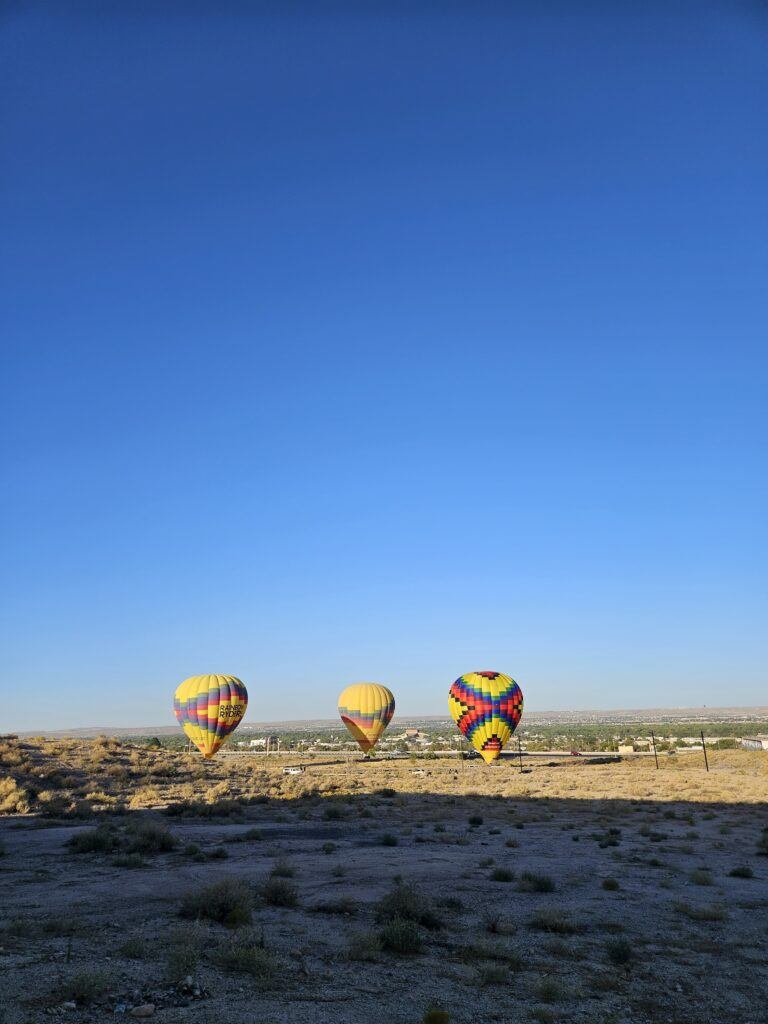
This is a photo of hot air balloons landing in a field in southeast Albuquerque where I ended up settling down new roots after my one year and three month excursion. MAC.
Traveling across the USA can be very rewarding and generally safe if you plan ahead and use common‑sense precautions. Below is a concise FAQ you can adapt or expand for your needs.
I must admit, I was pretty much winging it when I went on this excursion but there are practical measures to take if anyone is ready for an extended road trip across the USA. So, now for the questions:
Q: Is it safe to travel across the USA?
A: For most visitors, traveling across the USA is safe, especially in typical tourist areas, national parks, and well‑known cities, provided basic precautions are followed (watching belongings, avoiding high‑crime neighborhoods at night, and staying aware of surroundings.) I myself never had any fears for my safety.
Q: What basic safety tips should every traveler follow?
A: Lock car and accommodation doors, keep valuables out of sight, stay in well‑reviewed lodging, avoid walking alone late at night in poorly lit or deserted areas, and keep copies of important documents separate from originals. Of course, I did live in my converted school bus 90% of the time so locking my bus doors was my only concern almost every night on the road.
Getting around and road trips
Q: How safe is driving across the USA?
A: Highways are generally well maintained and driving is a popular, safe way to see the country, but aggressive driving, long distances, and severe weather require caution, rest, and checking forecasts before long stretches.
Q: Any specific tips for road‑trip safety?
A: Plan fuel and rest stops in advance, avoid sleeping in your car at roadside rest areas, use well‑lit parking, do not leave bags visible, and prefer established campgrounds or reputable truck stops for overnight halts. I did sleep in rest areas several nights but I had an RV (or a bus pretending to be an RV) so I considered that to be quite safe.
Q: Is public transportation safe?
A: In major cities, subways, buses, and trains are widely used and generally safe if you know your route, stay in well‑lit busy areas, keep bags close, and avoid empty cars or platforms late at night. Especially in NYC, do not enter the empty subway cars because they are empty for a good reason.
Interacting with people and places
Q: How should I handle interactions with strangers?
A: Most people are friendly and helpful, but avoid hitchhiking, be cautious about sharing personal details, decline invitations to isolated places from people you just met, and do not give rides or money if it feels unsafe.
Q: Are there cultural norms I should know?
A: Americans value personal space, generally appreciate direct but polite communication, expect tipping in many service situations, and may have different local customs between regions, so observing and asking politely goes a long way.
Natural hazards and environment
Q: What natural hazards should I be aware of?
A: Depending on region and season, travelers may encounter hurricanes, tornadoes, blizzards, wildfires, heatwaves, or earthquakes, so it is important to monitor weather, follow local guidance, and know basic emergency procedures.
Q: How can I stay safe outdoors?
A: In national and state parks, stay on marked trails, carry enough water, use sun protection, respect wildlife, and consider guided activities (like ranger‑led hikes) if you are unfamiliar with the terrain.
Experiences you can gain
Q: What kinds of experiences can I expect from traveling across the USA?
A: Travelers can experience a wide range of landscapes (deserts, mountains, coasts, forests), large multicultural cities, small towns, and a mix of arts, music, and local food scenes that vary significantly by region.
Q: Are there meaningful cultural experiences beyond typical sightseeing?
A: Yes—many visitors enjoy museum visits, local festivals, regional food tours, historical sites, and community events, which offer chances to learn about U.S. history, indigenous cultures, immigration stories, and contemporary local life.
Practical planning and peace of mind
Q: How can I reduce risk before and during my trip?
A: Share your itinerary with a trusted contact, stay informed through local news and official travel advisories, buy suitable travel insurance, and keep an eye on any updates about safety, weather, or transportation disruptions.
Q: What mindset helps balance safety and enjoyment?
A: Using situational awareness, respecting local norms, and preparing for long distances and weather variations lets you relax and focus on connecting with people, places, and cultures rather than worrying about worst‑case scenarios.
:
What an incredible journey! I felt like I was riding along with you through each town and state—the way you described Santa Fe, Ratón Pass, Denver, and eventually New Orleans really brought the road trip to life. The little details, like the smell of wood-burning fireplaces in Ashland or hitchhiking stories in Minnesota, made it so authentic. I’m curious—after all those adventures (and bus breakdowns!), which stop along your trip left the strongest impression on you personally?
Hello, thank you for the great comment. That was very encouraging. To answer your question, I think I have two choices because I have one most lasting negative impression and one most lasting positive impression. The negative inpression was from and adventure, my experience with the mother and son on the reservation. I never forget about how I would not bring them all the way into the village. I am sorry I did not do that I feel guilt and selfish that I did not help them more. I will always feel bad about that.
Then again my most positive impression was from Brinkley Arkansas because I was able to get involved with several families in the town and each of those families were very impoverished. I often bought groceries for the families and even babysitted at times. At least in Brinkley, I was able to create some strong bonds for a time. I am no longer in contact with any one there but I do feel I left a lasting impression for several families there. Anyway, thank you for the nice comment. MAC.
Wow, how many people are lucky enough to do this. Travel for a year and visit all the most beatiful places. Best yet you can explore on your own terms, as you are not bound by time or constrictions, and your home just travels along with you.l
I think I would love to follow the Mississippi River as you did. I would also love to see Illinois and Missouri. Maybe when I visit the states in future I am going to make an effort to see these places, as last year I only got to see Seattle, Orlando and some of LA.
Yes, it WAS quite an adventure. I really did not expect it take a whole year to accomplish but breaking down in Brinkley Arkansas will extend a trip for quite awhile. Luckily I had the kind of job that let me travel indefinatly and return again when I was ready. AAH, the good old days.???? MAC. Oh, and thank you for the very nice comment.
What an incredible journey — I loved reading about your one-year (and then some!) road trip from Santa Fe, New Mexico all the way through Colorado and beyond. Your vivid descriptions of the adobe-filled streets, the sweeping desert landscapes along I-25, and the mountain vistas on the way north really transported me there. I especially enjoyed how you didn’t just pass through each place, but took time to soak in its history and atmosphere — it makes the whole adventure come alive. Did you have a single most memorable “aha” moment on the road, when you felt the trip truly changed you?
Hello Hanna, thank you for the very nice comment. My most important “aha” moment was when I thought about the native Americans I gave a ride to. The next couple of days after I dropped them off, I could not help thinking that I should have been more open to bringing them all the way to their home. Those thoughts are most likely why I was willing to stay such a long time in Ashland Wisconsin and Brinkley Arkansas. Anyway, thank you for the great comment MAC.
This story resonates because it captures road travel as a lived rhythm rather than a checklist of destinations. What stands out to me is the sense of continuity. One year on the road is not about constant excitement, but about learning how places, seasons, and states of mind flow into one another.
I appreciate how the journey from Santa Fe through Colorado to Wisconsin is framed as a gradual unfolding. Landscapes change, but so does perspective. Long road trips teach you patience and attentiveness. You stop chasing highlights and start noticing mornings, weather, small towns, and quiet moments that would otherwise be overlooked.
From my perspective, extended travel like this is less about escape and more about recalibration. Being on the road strips life down to essentials. Where you sleep, how you eat, how you stay connected, how you remain grounded. That simplicity can be demanding, but it is also clarifying.
What makes this kind of journey meaningful is not distance, but presence. Staying long enough in motion to let routines dissolve and new ones form. In that sense, a year on the road is not a pause from real life, but a different way of inhabiting it. This piece reflects that truth well and avoids romanticizing travel while still honoring its depth.
Hello Farid, thank you for this wonderful comment. maybe I should switch the article with the comment as the comment speaks everything the article is about. Maybe this comment can be the article and the article becomes the comment. Thank you again for the comment here, I really love it. MAC.