If you are weighing long-term travel and have a pet, the first question is usually what to do with the animal. For us the answer was to bring our Bombay cat, and that decision changed how we think about home. This post covers what traveling life with a cat looks like in practice, what to plan for, and how to decide whether it suits your family.
Why we didn’t leave the cat behind
The usual advice for people who travel full-time is to rehome the pet, board it with relatives, or wait until the traveling is over. Those are reasonable choices, and some animals are better off staying put. We decided the cat comes with us, when we traveled by car.
Our reasoning was about what home is. If home is an address, leaving the address means leaving home. If home is the people and animals who share your days, it goes wherever they go. A cat who gets fed at the same time each morning and sits in the same lap each evening is part of that daily pattern.
For seniors and multigenerational families this matters more than it might seem. A pet gives the day a shape. Someone has to feed it, someone has to talk to it, and someone ends up with a warm lap. Those small jobs carry across borders easily.
Meet our Bombay cat: the personality that decided how we travel
Bombay cats are black, short-coated and usually described as people-oriented. The breed has a reputation for staying close to its household, following people from room to room and disliking long stretches alone. Our cat is a Bombay, and that attachment to people is a large part of why we travel with the cat as a companion rather than leaving it in someone else’s care. When we travel by plane, we leave our cat at home but our son or, if he joins us on the trip, our sister house/pet sits for us.

Breed reputation only goes so far, and your own cat is the one that counts. Some cats are bold and curious, others are cautious and want the same corner every day. Before you commit to traveling life with a cat, think honestly about which kind you have:
- Does your cat eat and use the litter box normally in unfamiliar places, such as the vet’s office or a relative’s house?
- Does it tolerate a carrier, or panic in one?
- Does it bond to people or to the territory?
- Is it healthy enough for travel? Your vet is the right person to judge that.
A cat that is attached to its people tends to cope with new places better than one that is attached to a particular house, because the people are the part that moves with it.
What a cat does to a new rental in the first 24 hours
Cats investigate. In a new rental, expect your cat to check every corner, climb onto anything climbable, and look for hiding places. Many cats go straight under a bed or behind a sofa and stay there for hours. That is normal behavior for an animal in unfamiliar surroundings. This is exactly what our cat does; under the bed she goes.
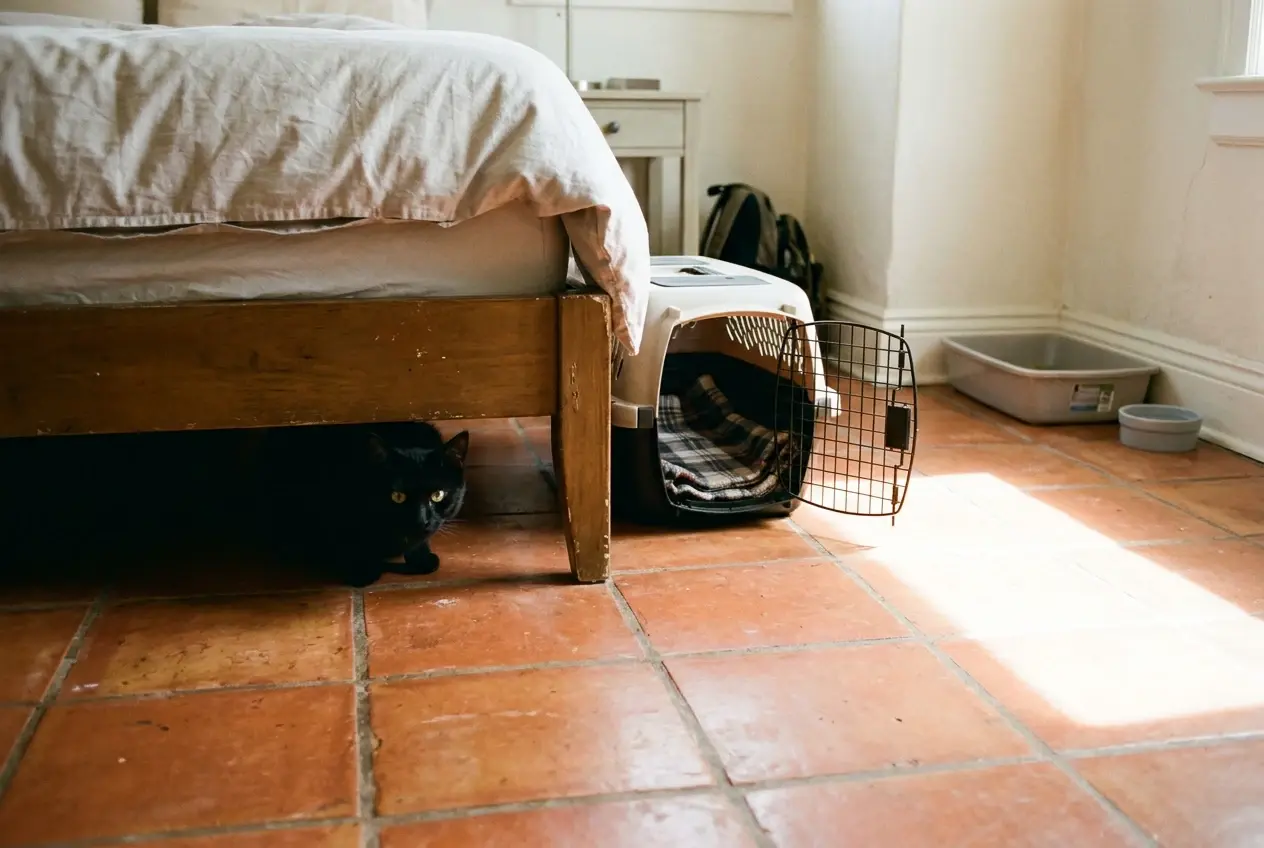
A few things are worth doing before you let the cat roam:
- Set up one room first. Put the litter box, water, food and the cat’s own blanket in a single room and let the cat start there. Open the rest of the place once it is eating and moving around calmly.
- Check windows and balconies. A cat can slip through a gap that looks too small, and many rentals abroad have no window screens. Check every opening before the cat is loose.
- Look for gaps and hazards. Look behind appliances, under the kitchen counter and around any plants. Some common houseplants are toxic to cats.
- Keep the carrier out. If the carrier stays in the room with the door open, the cat can use it as a hiding place, and it stops being a sign that something stressful is about to happen.
By the next morning most cats have claimed a sleeping spot and a window. That claim is the first sign the place is starting to work.
The routines that make any place feel like home
A cat does not care about the view or the neighborhood. It cares about when the food arrives, where the warm spot is and who is in the room. Those same things do a lot of the work of making a place feel like home for people too.

The routines that carry over best are small ones:
- Feeding at the same times every day, from the same bowls
- The same blanket or bed, which keeps a familiar scent
- A set evening ritual, such as brushing or a few minutes of play
- Your own morning habits, whether that is coffee on the balcony or a walk before breakfast
Keeping these fixed while everything else changes means a new apartment feels familiar within a couple of days. Cats seem to settle on routine more than on surroundings, and people do as well.
What to plan around: flights, paperwork and vet checks.
This is the part that needs the most care, and the part where you should not rely on a blog post, including this one. Rules differ by country and by airline, and they change. We do not bring our cat on flights but I have considered it and studied it many times. Here is what I have learned:
Common requirements include a microchip, a current rabies vaccination, and a health certificate from a vet, sometimes endorsed by a government authority. Some destinations add waiting periods, extra tests or quarantine. Some countries also have rules about what you need to bring the animal back home. This is a list of things to ask about, not a complete list of requirements.
Confirm the current rules with:
- The airline directly. Airlines set their own policies on cabin versus cargo, carrier size, weight limits, fees and the number of pets allowed per flight, and some limit cats on certain routes or in hot weather.
- The destination country’s official agriculture or veterinary authority. In the United States, the USDA’s APHIS pet travel pages are the starting point for exports.
- An embassy or consulate, if the official pages are unclear.
- Your own vet, who can tell you which vaccinations and paperwork windows apply and whether your cat is fit to fly.
Start early. Some destinations have requirements that take weeks to complete in the right order, and a missed step can mean a canceled trip. Seniors planning long flights with a pet may also want to read my post on major concerns for seniors during long plane flights, since carrying a cat adds to the load.
How a pet changes the way we choose where to stay and how long
A cat narrows the list of places you can stay, and it also makes the choice easier. Pet-friendly listings are the only ones worth considering, and the pet policy needs to be confirmed in writing with the host before you pay. Fees and deposits vary, so ask what they are rather than assuming.
A few other factors become important:
- A vet within reach. Look up a clinic near the rental before you arrive.
- Quiet and safety. Noisy streets and open balconies are harder to manage with a cat.
- Length of stay. Every move is stressful for the animal and means repeating the first-24-hours routine. Staying longer in fewer places suits a cat better than moving every few days.
For us, that last point fits slow travel well. If you plan to stay longer, check the rules for doing so legally, and my post on how to extend your stay and the visa options is a good place to begin.
The moments that taught us what home really means

A cat shows quickly what home is made of. It does not need a particular country. It needs a bowl in the usual spot, a sunny patch of floor, and its people close by. When those things are in place, it sleeps deeply, and that is how you can tell it feels at home.
People work much the same way, though we are better at hiding it. The sofa, the street and the language outside the window matter less than we expect. The morning routine, the familiar faces at the table and the animal curled up nearby matter more. Watching a cat settle into a new rental in a day or two is a good reminder that the address was only ever a small part of it.
Is it right for your family? Questions to ask before you pack the carrier
Not every pet should travel, and not every family should take one. Talk through these questions together:
- Is the animal healthy, and has your vet said it can handle the trips you are planning?
- How does it behave in carriers, cars and unfamiliar rooms?
- Can you afford the extra costs of paperwork, vet visits, airline fees and pet deposits?
- Who will handle the animal’s care if one of you is ill or traveling separately?
- Are the destinations you want realistic, given their import rules and quarantine requirements?
- What is the plan if the animal gets sick abroad or the trip has to end early?
If the answers are mostly yes, traveling life with a cat can work well, and the cat will probably teach you something about home along the way. If the answers are mixed, a shorter trial trip before a long move will tell you a lot.
Tell us in the comments what travels with you that makes a new place feel like home, whether it’s a pet, a person or a routine.